Happy Plug In Day to all my fellow EV'ers! (and Volt'ers ;) ) Another year has passed and what a year it has been! Things are looking much different now than it was on Plug In Day 2012.
In 2012; nearly all public plugs were free but scarce. The sales were dismal and huge sections of the country were not even aware that a 100% highway capable EV even existed. Huge incentives to buy or lease were being offered and people were getting 2012's for practically nothing in areas where state incentives were higher than normal.
Georgia was one of the best examples where high residuals combined with a $5,000 state perk allowed some LEAFers to lease at nearly break even prices. It took a while to catch on but now, Georgia and the Atlanta area is now in the same category as EV hotbeds, San Francisco, Seattle and Portland.
2012 was also the start of the very ugly battery degradation issue as many LEAFers entering their 2nd Summer were starting to lose their 2nd, 3rd and 4th capacity bars. The ugliness was mostly caused by Nissan's initial response.
At first they claimed surprise stating various tests they had performed that showed a robustness that we owners were not seeing. The fact that they had a test center near Phoenix (the center of the heat issue) did lend credence to their statements but increasingly, too many people were reporting losses and as the word got out and more became aware of it; the geography expanded from the ridiculously hot areas to places that were simply warm.
Accusations, lawsuits, threats and several other nasty things were soon flying all over the net. But Nissan's response? Silence...
and more silence....
and more silence....
Finally, they admitted that "further investigation was needed" and took 5 of the earliest reported LEAFs from the Phoenix area for in depth testing at their Arizona facility. They were gone a week or so and some actually came back with capacity bars restored (but most disappeared soon afterwards.) Nissan stated the instrumentation was a bit off and work on better software was the next step.
But sales remained tepid at best. They remained decent on the West Coast but still too many reports of people having to go 1-2 states away to get one elsewhere.
Then the 2013's came out. Reputed to have more range thru software tweaks, power train changes, etc but still the same ole battery pack. Tests later proved that they "might" have more range under special driving conditions but for mainstream commuting? Nada!
But the 2013's did have options including a cheap entry level S model (not a Tesla mind you! but can't help but wonder about the motivation behind the designation?) faster charging, more efficient heaters, etc along with finally an SOC gauge. Many cried it wasn't enough due to its simplicity but the gauge has proven to be relatively accurate. But that did not help us 2011/12 owners but that is ok. We have learned long ago, if we want something we just get er done! So Jim from AZ devised his own software to monitor the LEAF and now we have nearly everything! voltages, charge level, battery temps, etc!
But not all was rosy with the 2013 launch. Unexplained delays, widespread shortages, and incompatibility with public chargers hampered the 2013's. Nissan was able to sort it out eventually and with continued deep cuts on lease programs, they were selling every LEAF they could make.
After several months of record or near record sales, the "no brainer" lease deals became "good deals". But Atlanta with its awesome GA credits soon led the way overtaking both San Francisco and Seattle (although they were still doing very very well themselves) but the factory output has been slow to respond which means very limited selections if you were not lucky enough to be in the above mentioned areas.
By now; public charging has been going for as much as 2 years or more. But AV; who only was supposed to offer free charging for a few months is still free. Their website states a $2.50 fast charge session fee but that has not happened and persistent communication problems between the charger and their headquarters is probably part of the problem. But for the role they were to play, they have done very well at least in WA and OR in completely those sections of the West Coast Green Highway Project.
Ecotality on the other hand has been hit with various problems including compatibility with their level 2 chargers and the 2013 LEAFs with 6 KW charging capacity. Their solution was to turn down the power which was not a popular decision but did not generate nearly the bad juju as their announcement to start charging a flat $5 fee for fast charger use.
Personally I was more than a bit shocked at this decision. for one thing; the role out of the charging stations had been VERY slow and the few that were there (and working) had huge waits most of the time. (I am sure free had something to do with it) But a flat fee meant that many would charge longer than they needed to "get their money's worth" making lines longer and others who only needed a small boost would be unfairly treated. I am in the latter camp. In my QC sessions; 60% of them were 15 mins or less. The other 40% includes several "full charge" tests that were more experimental than need. In these tests, I have aborted the tests 8 times due to someone else pulling up after 15 minutes and I did not want them to wait since I did not have a need to charge. So in reality; my need for more than 15 minutes of charging is probably more in the line of ¼ of the time or less.
With the immediate feedback; Ecotality backed off a bit. In high electricity rate areas, they went ahead with the flat fee but delayed it in the Pacific Northwest and I think the reason for that is our much cheaper power. Eventually they came up with a scheme that they would use various rate plans and we could "vote" for our choice with our usage but the flat fee went into effect anyway for us as well. I have yet to vote when I did not need an 80% charge or better having opted for the $1 an hour L2 charge 5 times so far. Still no word from Ecotality when and what the other "votes" will be...
Something that might be affecting that is Ecotality announcing bankruptcy. They had basically not met the Feds guidelines for the EV Highway Project and had missed several deadlines and the Feds pulled funding and now Ecotality has nearly no revenue. They were still able to open up a few more fast chargers after the announcement but the future of the company (and the chargers) is uncertain at best.
What will most likely happen is someone else will take over the chargers and then we will have to see what happens from there.
SemaConnect has made a lot of installs in the area as well mostly at Walgreens. They actually sell the charger and maintenance package to the hosts. Up until a few months ago; charging was free and by far the easiest. although cards were issued, you did not need to use one. But then they came out with a 49 cent/kwh charge nationwide. To be honest with ya; that is ok with me. It is a bit steep compared to other companies but its based on what you receive which is how gas, electricity, etc is treated by EVERYONE else. In this respect; Ecotality's buck an hour is much cheaper! But Sema does provide other options (and competition especially when now Walgreens is like "Charge City" where we have Sema's L2's along with Ecotality's L2s AND Fast Chargers to choose from!
Anywho; that is the year in a nutshell. So what's next? As I see it; we really need to get this public charging fiasco resolved. I have blogged several times that the states should pick up the slack. the West Coast Green Highway Project was genius and really helped to encourage people to get out and about in the LEAFs! This is a perfect tourist tool!
Now; I am not suggesting we put these chargers out for free. This would only cause a 4 car line at Tumwater like what happened on Labor Day Weekend. Charge for Charging! Make it reasonable. Put the chargers on routes to destinations that need tourist dollars. Too many people wishing they could go to the beach. Ocean Shores is reachable but only a half dozen of us are willing to take the risk. Harbor Paper near Aberdeen, WA was supposed to help revitalize the struggling economy in Gray's Harbor County but they are on hard times. This is just plain wrong! The state could help by putting in stations in the area. Power cost is very low there and this will help direct more tourist dollars when people have to stop for 20-30 mins to get a boost. This does not happen when driving gas car when you fill up in Seattle and drive straight thru Aberdeen or Montesano without stopping!
The other thing we need to look at is employee charging. There are a handful of companies providing stations but too many that are not. Once again; the easiest thing here is a state mandate requiring employers to step up. Several good things have come with a bit of arm twisting and a gentle shove in the back and this needs to be one of them. Kudos to WA State and others for now making "ICE'ing" illegal and fineable!
What else do we need to work on?? Post your suggestions!
Saturday, September 28, 2013

Sunday, September 15, 2013
Cmon Winter! Should I be saying that??
Ya, what's up with that? Don't I lose like 10 miles of range in the cold and wet? Actually I do and I dread dusting off the heated jacket and what not but at the same time; its becoming apparent my LEAF is looking forward to cooler times.
As mentioned previously; Keith was nice enough to send me an "ELM" a small bluetooth enabled device that reads the CAN bus data and transmits it to my old Motorola Droid X phone. One of the many bits of information it sends is two metrics that monitor battery pack state and health which are total capacity measured in amp-hours and Battery health which gives one an overall picture of how well the pack is feeling in a way. Naturally these are two things we want to track for the long term.
When I first started using the ELM a few weeks back I was at 58.09 Ahr and health was 76.60%. but both numbers started to declined immediately on a daily basis. On Wed, I recorded Ahr reading of 57.57 and batt health of 75.74% (temps were in the 90's) and was resigning myself to losing my first bar by mid October, but...
**The weatherman had predicted temps in the low 90's and mid 80's for the week but that did not happen. a weather system blew in off the Pacific and parked itself (could not make it over the mountains I guess) and so we have had cloudy overcast and COOL days with temps mostly in the 60's with brief touches in the low 70's. Mornings cool in the upper 50's.
** LEAF not being used. Had 150 mile run on Friday so took the gasser so LEAF just did errands and logged 35.2 miles. Since I did not work Saturday, I decided not to charge overnight instead opting to plug in first thing in the morning which I did about 5 AM and also opened garage door as well. Temps were in mid 50's. Started running errands Sat and eventually went 102 miles with a 10.83 Kwh QC at Tumwater AV which shot my batt temps to 88º (highest reading so far!) Temps were 65ish until late afternoon when the Sun finally came out. Don't know the official score but guessing best we got was 70 maybe...
Today is late job so opted to not charge last night again and did the same plugging in this morning and opening garage door. Then went out for short trip and about freaked out when Batt App booted up. My ahr reading 58.29!! Health was 77.09% both all time high readings!
So basically, it took 2½ days of cool weather and light driving for the BMS to readjust?? really looking forward to any changes in the next few days. Work schedule is not light but early part of the week, all the work is in town so should be light driving.
My only regret is I did not do a full charge (only had 11 bars) so don't know if the GID count has rebounded but hoping for something in the 250 range!
As mentioned previously; Keith was nice enough to send me an "ELM" a small bluetooth enabled device that reads the CAN bus data and transmits it to my old Motorola Droid X phone. One of the many bits of information it sends is two metrics that monitor battery pack state and health which are total capacity measured in amp-hours and Battery health which gives one an overall picture of how well the pack is feeling in a way. Naturally these are two things we want to track for the long term.
When I first started using the ELM a few weeks back I was at 58.09 Ahr and health was 76.60%. but both numbers started to declined immediately on a daily basis. On Wed, I recorded Ahr reading of 57.57 and batt health of 75.74% (temps were in the 90's) and was resigning myself to losing my first bar by mid October, but...
**The weatherman had predicted temps in the low 90's and mid 80's for the week but that did not happen. a weather system blew in off the Pacific and parked itself (could not make it over the mountains I guess) and so we have had cloudy overcast and COOL days with temps mostly in the 60's with brief touches in the low 70's. Mornings cool in the upper 50's.
** LEAF not being used. Had 150 mile run on Friday so took the gasser so LEAF just did errands and logged 35.2 miles. Since I did not work Saturday, I decided not to charge overnight instead opting to plug in first thing in the morning which I did about 5 AM and also opened garage door as well. Temps were in mid 50's. Started running errands Sat and eventually went 102 miles with a 10.83 Kwh QC at Tumwater AV which shot my batt temps to 88º (highest reading so far!) Temps were 65ish until late afternoon when the Sun finally came out. Don't know the official score but guessing best we got was 70 maybe...
Today is late job so opted to not charge last night again and did the same plugging in this morning and opening garage door. Then went out for short trip and about freaked out when Batt App booted up. My ahr reading 58.29!! Health was 77.09% both all time high readings!
So basically, it took 2½ days of cool weather and light driving for the BMS to readjust?? really looking forward to any changes in the next few days. Work schedule is not light but early part of the week, all the work is in town so should be light driving.
My only regret is I did not do a full charge (only had 11 bars) so don't know if the GID count has rebounded but hoping for something in the 250 range!
Monday, September 2, 2013
ELM LEAF Battery Monitoring App
Knowing exactly how far you can go in your car has been Man's quest since the dawn of the automobile. Hundreds, maybe even thousands run out of gas every day due to their miscalculated risk from that remaining sliver on the gas gauge.
Having an EV does not make that calculation any harder, just have to do it more often. I calculate my remaining range nearly every day to make sure I can make it. I usually have to adjust my driving habits early to account for the planned trips for the day. Helping me with that is the "GID Meter" which is a CAN monitoring device designed by MNL'er Gary Giddings. It tells me a very good approximation of my GID count which allows me to track how many GIDs I have used so I can use my trip meters to determine how far those GIDs have taken me and with previous experience with the planned route of the day, should tell me whether I can make it or not.
All that means a lot of math on my part which is ok. Its not complicated or difficult but there was a lot of things that the GID meter did not provide at all.
This Summer has been one of the hottest overall that I can remember. Mind you, no super high temps like that 2 week run we had in 2009 when we had 4 days over 100º or 11 of 12 days over 90. In fact, we have only had a handful of days in the 90's but the real story is the string of days we have had in the 80's.
To better understand what I am getting at, lets talk about last Summer. Last Summer was only slightly cooler than normal. We had mostly cool rainy weather up thru nearly the middle of July (about 1-2 weeks longer than normal) then dry but not very warm weather for July with the real Summer weather in August running up thru about mid Sept.
This year, we had one of the warmest and driest May and June and that has extended into July and August. Now, we had a downpour (one of the hardest rains I have ever experienced anywhere!) last Thursday which I am guessing will create stats that one will look at next year that will make the numbers from the Summer of 2013 blend into the masses...
Either way, my GID count which has been discussed often here was in the upper 260's low 270's in April which included an occasional 275 or so. I was very impressed that after 30,000 miles, my batteries were holding up so well.
But then the heat started and my batteries declined almost instantly to the mid 250's. I got the software update that was supposed to increase accuracy of gauges and saw another quick drop into the mid 240's that continued until settling into the mid 230's. Since it all happened right when the heat of Summer did, I felt the coincidence to be a bit too much to ignore.
Than Jim, another MNL'er came up with an Android based monitoring system that provided much more information including battery temps and individual cell voltages. This would allow me to see if there was a loose correlation between GID counts on a full charge and battery temps along with checking my pack balance. Software is here
This was a project I was very interested in but work got in the way and I put it off and put it off and put it off. But Keith a Seattle area Facebook LEAF owner sent me the ELM interface which plugs into the CAN port on the LEAF and transmit info to a Android phone via Bluetooth. So, now I had no excuses. (Thank you Keith!)
I wanted to use my old Droid Bionic because it had better batteries but it simply would not connect to the ELM. After determining I was doing everything right (after all its like setting up any other BT connection. very easy for anyone interested in doing this!) I figured phone did not work. It had droid version 2.4 (i think) and most of the phones on the compatibility list seemed to have version 2.2) so I wrangled my ancient Motorola Droid X from my Son (he uses it to play games and you tube) and the program worked like a charm.
Today was first day I had a chance to do a full charge and actually look at the data (just because its Labor Day weekend does not mean I get the weekend off. I do get today off and that is about it!)

This screen shows each cell module voltage (good balance here! 21 mV difference) and my estimated capacity of 58.09 AHr (full capacity about 66.6) or 87.67% which aligns closely with my GID percentage from a "full" 281. Battery Health is76.6% (a measure of internal resistance. more on this later as soon as I find out what it means) and all batt temp modules running around 76º. This charge completed at 1 AM and this pix was taken at 6:30 AM.

Here is another screen that adds estimated range. This is shown at 4.2 miles/Kwh which is basically about what I get if driving along at 60 mph per LEAF speedometer during Summer. FYI; during the time I was playing around, my SOC actually dropped from 93.3 to the 92.8 you see here... Gives you an idea of just how weak the GIDs at the top of the pack seem to be.
For anyone out there who approaches the range of their LEAF, a monitoring system is vital to have. This allows one a much better picture of just how much is left in the batteries. Steve Marsh; our local LEAF mileage champ (probably #1 in the entire country!) was stopping 1-2 times on his daily commute to charge on the road due to range anxiety. This meter has allowed him to not stop. So, ya he is pulling into work maybe on his last mile but after all, that is all he needs right?
The best part of the ELM option is that its cheap. Even if you dont get a device given to you, they run under $20. Same with the phone. I am using a Motorola Droid X which was the top of the line Android Phone...about 4 years ago! So it or something similar can be had for no more than $30 at a used cellphone store or online.
For more details on its operation a good wiki is available at MNL
http://www.mynissanleaf.com/wiki/index.php?title=Leaf_Battery_Application#Screen_1
Having an EV does not make that calculation any harder, just have to do it more often. I calculate my remaining range nearly every day to make sure I can make it. I usually have to adjust my driving habits early to account for the planned trips for the day. Helping me with that is the "GID Meter" which is a CAN monitoring device designed by MNL'er Gary Giddings. It tells me a very good approximation of my GID count which allows me to track how many GIDs I have used so I can use my trip meters to determine how far those GIDs have taken me and with previous experience with the planned route of the day, should tell me whether I can make it or not.
All that means a lot of math on my part which is ok. Its not complicated or difficult but there was a lot of things that the GID meter did not provide at all.
This Summer has been one of the hottest overall that I can remember. Mind you, no super high temps like that 2 week run we had in 2009 when we had 4 days over 100º or 11 of 12 days over 90. In fact, we have only had a handful of days in the 90's but the real story is the string of days we have had in the 80's.
To better understand what I am getting at, lets talk about last Summer. Last Summer was only slightly cooler than normal. We had mostly cool rainy weather up thru nearly the middle of July (about 1-2 weeks longer than normal) then dry but not very warm weather for July with the real Summer weather in August running up thru about mid Sept.
This year, we had one of the warmest and driest May and June and that has extended into July and August. Now, we had a downpour (one of the hardest rains I have ever experienced anywhere!) last Thursday which I am guessing will create stats that one will look at next year that will make the numbers from the Summer of 2013 blend into the masses...
Either way, my GID count which has been discussed often here was in the upper 260's low 270's in April which included an occasional 275 or so. I was very impressed that after 30,000 miles, my batteries were holding up so well.
But then the heat started and my batteries declined almost instantly to the mid 250's. I got the software update that was supposed to increase accuracy of gauges and saw another quick drop into the mid 240's that continued until settling into the mid 230's. Since it all happened right when the heat of Summer did, I felt the coincidence to be a bit too much to ignore.
Than Jim, another MNL'er came up with an Android based monitoring system that provided much more information including battery temps and individual cell voltages. This would allow me to see if there was a loose correlation between GID counts on a full charge and battery temps along with checking my pack balance. Software is here
This was a project I was very interested in but work got in the way and I put it off and put it off and put it off. But Keith a Seattle area Facebook LEAF owner sent me the ELM interface which plugs into the CAN port on the LEAF and transmit info to a Android phone via Bluetooth. So, now I had no excuses. (Thank you Keith!)
I wanted to use my old Droid Bionic because it had better batteries but it simply would not connect to the ELM. After determining I was doing everything right (after all its like setting up any other BT connection. very easy for anyone interested in doing this!) I figured phone did not work. It had droid version 2.4 (i think) and most of the phones on the compatibility list seemed to have version 2.2) so I wrangled my ancient Motorola Droid X from my Son (he uses it to play games and you tube) and the program worked like a charm.
Today was first day I had a chance to do a full charge and actually look at the data (just because its Labor Day weekend does not mean I get the weekend off. I do get today off and that is about it!)

This screen shows each cell module voltage (good balance here! 21 mV difference) and my estimated capacity of 58.09 AHr (full capacity about 66.6) or 87.67% which aligns closely with my GID percentage from a "full" 281. Battery Health is76.6% (a measure of internal resistance. more on this later as soon as I find out what it means) and all batt temp modules running around 76º. This charge completed at 1 AM and this pix was taken at 6:30 AM.
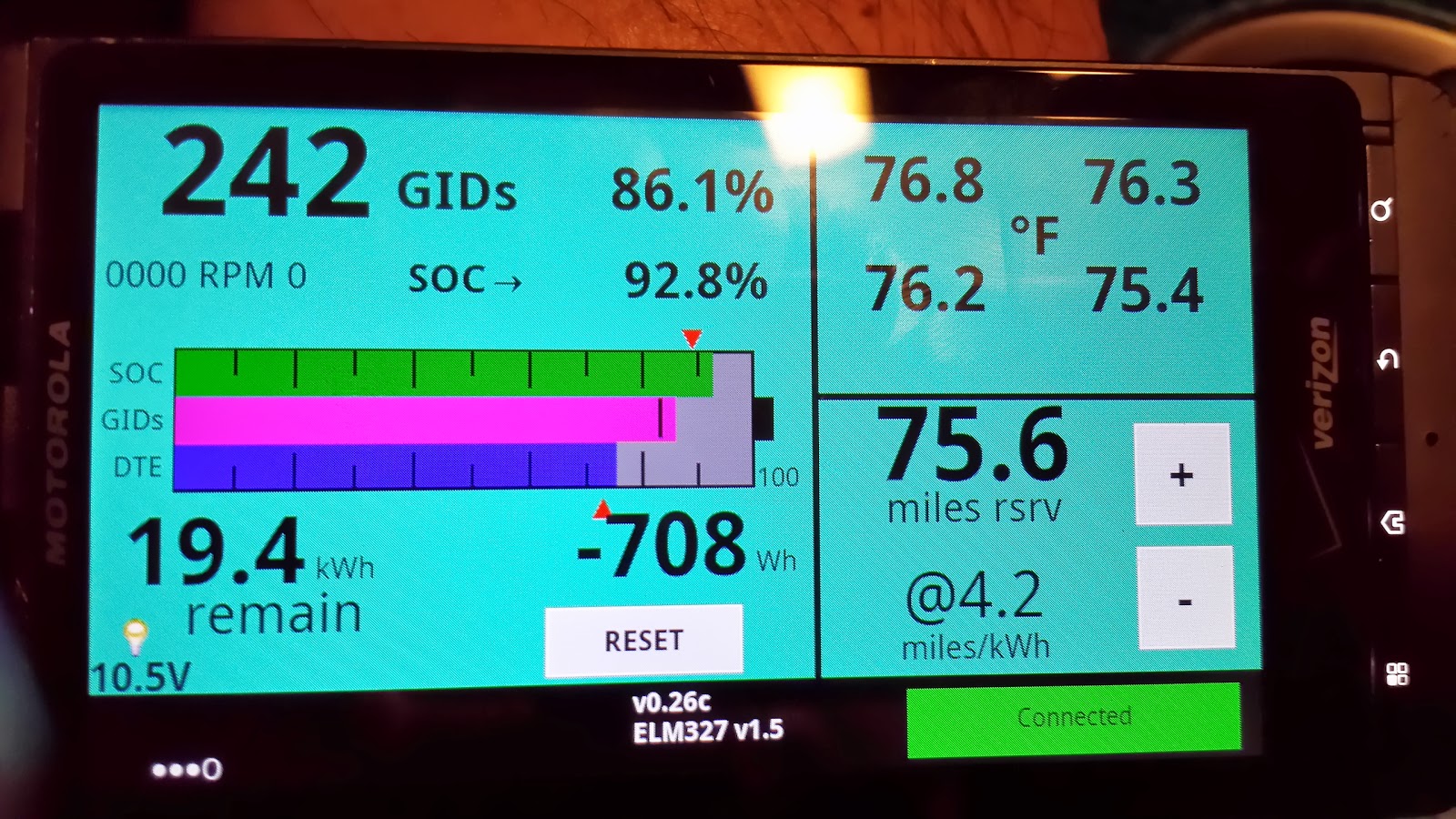
Here is another screen that adds estimated range. This is shown at 4.2 miles/Kwh which is basically about what I get if driving along at 60 mph per LEAF speedometer during Summer. FYI; during the time I was playing around, my SOC actually dropped from 93.3 to the 92.8 you see here... Gives you an idea of just how weak the GIDs at the top of the pack seem to be.
For anyone out there who approaches the range of their LEAF, a monitoring system is vital to have. This allows one a much better picture of just how much is left in the batteries. Steve Marsh; our local LEAF mileage champ (probably #1 in the entire country!) was stopping 1-2 times on his daily commute to charge on the road due to range anxiety. This meter has allowed him to not stop. So, ya he is pulling into work maybe on his last mile but after all, that is all he needs right?
The best part of the ELM option is that its cheap. Even if you dont get a device given to you, they run under $20. Same with the phone. I am using a Motorola Droid X which was the top of the line Android Phone...about 4 years ago! So it or something similar can be had for no more than $30 at a used cellphone store or online.
For more details on its operation a good wiki is available at MNL
http://www.mynissanleaf.com/wiki/index.php?title=Leaf_Battery_Application#Screen_1
Wednesday, August 21, 2013
Blink QC's Starting $5 Fees in Northwest
By now, anyone in the EV world has heard that Ecotality is on the skids. They have not honored their contractual obligations with the Feds (that is a HUGE understatement!) and so the Feds stopped paying them.
So the much desired DCFCs slated for the Olympic Peninsula and other areas like South Pierce County are most likely on permanent hold which is a huge disappointment to me. The mention of a fast charger in DuPont put a smile on my face and would have been a perfect place to put one for my commute north and would really be helpful especially now that my LEAF is finally starting to lose some range.
So its a bit strange that yesterday I received an email advising that starting tomorrow, Ecotality will start the $5 per session fees for their fast charge stations. So despite a huge uproar over the injustice of such a thing, they went ahead and did it anyway.
Well, someone (from Ecotality I am fairly sure) said that the current software was unable to bill by time or the amount of charge taken. Which really means the station does not have the ability to provide instant feedback as to the cost of the charge at the end of the session. Well, if that is all that is standing in the way, then bring it on! If need be, I can log into the Blink website the next day and find out what the charges were. I am ok with that. They do tell you how much charge you took so charging by the Kwh is doable. And they also tell you the duration of the charge so charging by time is doable so all the tools to bill by time or charge is available but just not instantaneously. So lets see just how easy it would be!
I went to my Blink link and logged in. After a bit of wandering, I found what I was looking for...
here is copy of transaction I made. Got this info from
https://www.blinknetwork.com/profile/transaction-history.html
So the much desired DCFCs slated for the Olympic Peninsula and other areas like South Pierce County are most likely on permanent hold which is a huge disappointment to me. The mention of a fast charger in DuPont put a smile on my face and would have been a perfect place to put one for my commute north and would really be helpful especially now that my LEAF is finally starting to lose some range.
So its a bit strange that yesterday I received an email advising that starting tomorrow, Ecotality will start the $5 per session fees for their fast charge stations. So despite a huge uproar over the injustice of such a thing, they went ahead and did it anyway.
Well, someone (from Ecotality I am fairly sure) said that the current software was unable to bill by time or the amount of charge taken. Which really means the station does not have the ability to provide instant feedback as to the cost of the charge at the end of the session. Well, if that is all that is standing in the way, then bring it on! If need be, I can log into the Blink website the next day and find out what the charges were. I am ok with that. They do tell you how much charge you took so charging by the Kwh is doable. And they also tell you the duration of the charge so charging by time is doable so all the tools to bill by time or charge is available but just not instantaneously. So lets see just how easy it would be!
I went to my Blink link and logged in. After a bit of wandering, I found what I was looking for...
here is copy of transaction I made. Got this info from
https://www.blinknetwork.com/profile/transaction-history.html
Transaction Details
Tahoma Market (I-5 Exit 137)
6006 Pacific Highway East
I-5 Exit 137
Fife, WA 98424 US
2013-04-03 05:27:26 EDT
9 minutes
$0.00/charge
$0.00
002510975
Tahoma Market (I-5 Exit 137)
6006 Pacific Highway East
I-5 Exit 137
Fife, WA 98424 US
6006 Pacific Highway East
I-5 Exit 137
Fife, WA 98424 US
2013-04-03 05:27:26 EDT
9 minutes
$0.00/charge
$0.00
002510975
So got the time down to the second! Now, I have to go to the Dashboard and go thru some convoluted math aerobics but I can also figure out how much Kwh I collected in this session here
https://www.blinknetwork.com/dashboard
Here I will find I reduced my CO2 usage by 2.4 lbs. I saved $1.30 or .5 gallons of gas (Where do they buy their gas from???) and after some of the that above mentioned math; 5.185 Kwh. (there is no way I can find on the site that gives you that information directly...)
So even on the website, getting the pertinent info to charge by Kwh is not an easy task. Why a seemingly critical piece of information was omitted from the transaction "details" screen is beyond me but not the point. The important thing is that all the data is present.
Either way, the announcement brought on the usual outrage online. the "Dusting off the Prius" statements were flying all over Facebook as can be expected but there is another thing to consider; $5 for a vital charge to get somewhere is actually not a bad deal in my mind. But the transaction I posted above is typical for me. So I would be paying a buck a Kwh! Not a good deal. But then again, I was only wanting to make it home (or to work. At 2:30 AM its very possible I could have been heading to work...) so flat rates SUCK!
Then again, you cant equate $5 public charge against $5 of gas and the reason is that that your cost to charge drops to $2 when you get home (at least around here is does and remember this post is about Blink starting the per session fees in the NW right?) but gas aint any cheaper at home, catch my drift?
So supposing we use a real life example of my Yaris and its current 12 cents a mile performance (every once in a while i get to the mid 11's...) I drive 120 miles, its gonna cost me $14.40 in gas more or less.
So in the LEAF; I stop at Tahoma, grab a milkshake and a 30 minute QC; which would probably give me 40-50 miles of range but more likely 40 than 50 since I would not be rolling in on empty (although I usually do...) So, I got 40 miles for $5. Then I go home charge up to full for $2 and now I got 80 miles. So I have the same 120 miles and its $7
Oh, I here grumbling from the Prius corner. So supposing I am driving a 50 mpg Prius and got a bargain at the gas station for $3.60 a gallon. Well, now its 7.2 cents a mile but still adds up to $8.64. Now, you have to argue that stopping for 30 minutes to charge is much more inconvenient than stopping 10 minutes for gas.
Well, lets examine that situation first. I tend to work weird hours which is good because I rarely have a line to wait in while charging at 3 AM. So I pull up, plug in and walk into the store (which is ALWAYS open) get some refreshments, catch up on my email (my boss sends me about a half dozen emails a day along with several texts and phone calls) and correspondences.
OR
The gas station which always has a line but I only get gas at Costco (I am in awe of the CEO's treatment of its employees so I support!) But we will pretend its a short line. So i sit there. Now i can get some correspondence done but 5 minutes is usually not enough time to do much of anything... Leaving the car to get refreshments is out... I am basically trapped. I get to the pump, fill up and leave. Out in 10 minutes. Now I have to pull over to get my correspondence in anyway. I usually have to write so doing most if it on the road is not an option. So, its "only" 10 minutes but its 10 minutes that can't be really used for anything else but getting gas.
So, back to the charging station. I still have 20 minutes left but by now, I have covered bathroom (which would add 4 minutes to the gas station time) half of lunch, drink and on my 3rd email response. I will admit due to Ecotality's clunky system, I did waste 1.7 minutes getting thru the "yes i want to charge" exercise but that is about it...
So which is more inconvenient?
Either way, I am not advocating a per session fee by any means but if its the only way I can get some chargers in the North end of the county, so be it! I will do whatever I can to avoid Blink until they "try out" other charging methods. I have no doubt, the other methods will be more expensive for most but betting it wont be for me!
https://www.blinknetwork.com/dashboard
Here I will find I reduced my CO2 usage by 2.4 lbs. I saved $1.30 or .5 gallons of gas (Where do they buy their gas from???) and after some of the that above mentioned math; 5.185 Kwh. (there is no way I can find on the site that gives you that information directly...)
So even on the website, getting the pertinent info to charge by Kwh is not an easy task. Why a seemingly critical piece of information was omitted from the transaction "details" screen is beyond me but not the point. The important thing is that all the data is present.
Either way, the announcement brought on the usual outrage online. the "Dusting off the Prius" statements were flying all over Facebook as can be expected but there is another thing to consider; $5 for a vital charge to get somewhere is actually not a bad deal in my mind. But the transaction I posted above is typical for me. So I would be paying a buck a Kwh! Not a good deal. But then again, I was only wanting to make it home (or to work. At 2:30 AM its very possible I could have been heading to work...) so flat rates SUCK!
Then again, you cant equate $5 public charge against $5 of gas and the reason is that that your cost to charge drops to $2 when you get home (at least around here is does and remember this post is about Blink starting the per session fees in the NW right?) but gas aint any cheaper at home, catch my drift?
So supposing we use a real life example of my Yaris and its current 12 cents a mile performance (every once in a while i get to the mid 11's...) I drive 120 miles, its gonna cost me $14.40 in gas more or less.
So in the LEAF; I stop at Tahoma, grab a milkshake and a 30 minute QC; which would probably give me 40-50 miles of range but more likely 40 than 50 since I would not be rolling in on empty (although I usually do...) So, I got 40 miles for $5. Then I go home charge up to full for $2 and now I got 80 miles. So I have the same 120 miles and its $7
Oh, I here grumbling from the Prius corner. So supposing I am driving a 50 mpg Prius and got a bargain at the gas station for $3.60 a gallon. Well, now its 7.2 cents a mile but still adds up to $8.64. Now, you have to argue that stopping for 30 minutes to charge is much more inconvenient than stopping 10 minutes for gas.
Well, lets examine that situation first. I tend to work weird hours which is good because I rarely have a line to wait in while charging at 3 AM. So I pull up, plug in and walk into the store (which is ALWAYS open) get some refreshments, catch up on my email (my boss sends me about a half dozen emails a day along with several texts and phone calls) and correspondences.
OR
The gas station which always has a line but I only get gas at Costco (I am in awe of the CEO's treatment of its employees so I support!) But we will pretend its a short line. So i sit there. Now i can get some correspondence done but 5 minutes is usually not enough time to do much of anything... Leaving the car to get refreshments is out... I am basically trapped. I get to the pump, fill up and leave. Out in 10 minutes. Now I have to pull over to get my correspondence in anyway. I usually have to write so doing most if it on the road is not an option. So, its "only" 10 minutes but its 10 minutes that can't be really used for anything else but getting gas.
So, back to the charging station. I still have 20 minutes left but by now, I have covered bathroom (which would add 4 minutes to the gas station time) half of lunch, drink and on my 3rd email response. I will admit due to Ecotality's clunky system, I did waste 1.7 minutes getting thru the "yes i want to charge" exercise but that is about it...
So which is more inconvenient?
Either way, I am not advocating a per session fee by any means but if its the only way I can get some chargers in the North end of the county, so be it! I will do whatever I can to avoid Blink until they "try out" other charging methods. I have no doubt, the other methods will be more expensive for most but betting it wont be for me!
Topping Off Part 2
I mentioned that I started topping off the pack to see if it would help with my range and it has given me a few miles but I also noticed another thing; the topped off GIDs seem to last longer. So I decided to measure it to see.
First I did the regular charging thing. Leave times ran usually 5:30-6 AM with finish charge times running 1-3 AM. So the "chart" below lists starting GID then miles driven on first 5 GID and total miles driven for first 10 GID
238/1.2/2.6
235/1.3/2.6
240/1.3/2.7
238/1.3/2.7
The next set of numbers is having charge complete (usually by 1-2 AM or at least 3 hours before estimated leave time. Purposely tried to finish charge earlier to account for any possible balancing)
Then I simply unplugged the car and plugged it back in. Did my normal morning routine then took off. My intention was to check before and after GIDs but had two 4 AM starts last week so that plan got derailed by the snooze button...)
246/1.4/2.9
250/1.6/3.3
248/1.5/2.9
250/1.5/3.1** Late start no headlights but seems to have not made much of a difference.
246/1.7/3.2
As you can see, adding a tiny bit of "fresh" charge seems to give me up to an extra ½ mile of range for the first 10 GID. As far as why its happening? dont know but does seem fairly repeatable.
Any thoughts?
First I did the regular charging thing. Leave times ran usually 5:30-6 AM with finish charge times running 1-3 AM. So the "chart" below lists starting GID then miles driven on first 5 GID and total miles driven for first 10 GID
238/1.2/2.6
235/1.3/2.6
240/1.3/2.7
238/1.3/2.7
The next set of numbers is having charge complete (usually by 1-2 AM or at least 3 hours before estimated leave time. Purposely tried to finish charge earlier to account for any possible balancing)
Then I simply unplugged the car and plugged it back in. Did my normal morning routine then took off. My intention was to check before and after GIDs but had two 4 AM starts last week so that plan got derailed by the snooze button...)
246/1.4/2.9
250/1.6/3.3
248/1.5/2.9
250/1.5/3.1** Late start no headlights but seems to have not made much of a difference.
246/1.7/3.2
As you can see, adding a tiny bit of "fresh" charge seems to give me up to an extra ½ mile of range for the first 10 GID. As far as why its happening? dont know but does seem fairly repeatable.
Any thoughts?
Friday, August 9, 2013
How my Dad Raised an EV'er (My Dad's "Big Fish" Story)
Last Friday August 2nd, 2013 my Dad Neal passed away from complications of a stroke and Cancer. He was 85 and had lived a long and fruitful life. Its funny in that when growing up, my Dad and I did not get along much and it really was a combination of my stubbornness, his inability to show affection and the way he was raised. But he did love me in his own way and it took decades for me to understand and realize the true depth of that love. As much as I vowed to be a different kind of person growing up, I now realize that we are very much alike in both the good and the bad.
A few of the traits I acquired from him were being cheap (as others have noted, I call it being "financially reasonable") and the drive to work a bit harder if need be to get a desired result rather than paying someone else to do it for me. It is the latter part that made me realize that is why I got an EV. After all, EVs do require compromise. They require more planning, patience, and effort to incorporate it into my transportation lifestyle. Without really knowing him or me, it would be really impossible to illustrate my point so I thought it best to simply relate some of the various memories I have that really show his ability to adapt and his tenacity in making things work.
He was always good with his hands and was the best at fixing things of anyone I ever knew. Being raised during the Depression probably helped. In those days, you fixed things simply because buying another one was out of the question. He told me once about a trip he made with my Grandmother and Aunt in Northern MI years before the Highway System was built. The trip was probably around 200 miles and during the trip that lasted several hours that included fixing flat tires. In those days, a flat meant removing the tire from the car, then popping it off the rim (a job that was NOT easier then as it is today) removing the inner tube. patching it, then putting it all back together and using a bicycle like pump to air it back up. During that single trip he had to do this TWENTY THREE TIMES!
We also became the first on our block to get a color TV back in the early 60's. He built one from a Heath Kit. Saved a ton of money (TVs were really spendy back then) doing it and gained valuable experience from it allowing him to get a part time job repairing TVs soon afterwards.
He graduated from high school in Cheboygan MI and was promptly drafted in 1946 and sent to Germany. He did his hitch and returned to MI bouncing around from job to job and finally re-enlisted to stay. He was sent to Ft Lewis WA in preparation for Korea but was held back due to his "abilities" and was put in the Army Corps of Engineers and sent to Okinawa to install Radar Stations.

(Like the movie "Big Fish" I also have proof! Here is my Dad with a record catch of the coast of Okinawa...for about 2 hours. Unfortunately his boat mate broke the record as well! The caption states "near record weight" which is actually incorrect as both fish broke the previous record. He did later receive a certificate recognizing his achievement)
There his electrical/mechanical aptitude allowed him to be selected for a special project installing Nike Missile sites (aimed at China).

This where he met my Mom, Mitsuko Akamine and they were married and my brother Ken and I were born there.
My dad's performance with the missile sites along with the additional training he received allowed him to apply and be accepted into the highly exclusive new Nuclear Power Generation Group and transferred him to Alexandria VA at Ft. Belvoir. (where my Sister was born) The main purpose of this group was investigating the viability of providing a portable nuclear-based power supply to troops in various conditions around the world when deployed in areas where power may not be available. Initially, 4 sites were chosen. Ft. Belvoir in VA; Camp Century, Greenland; Ft Greely, Alaska and the Panama Canal Zone. This would provide ample power to the troops without the worry of maintaining a fuel supply line.
After completing training (which many started but did not complete. His graduating class had more instructors than graduates!)

(There were only 7 graduates. the back two rows are instructors except the guy in the middle of the 2nd row. The class started with over 30 people)
He was stationed at Ft Belvoir, VA and then went TDY (term for short term duty at a remote station) to Camp Century Greenland. Here the power plant sat on what was thought to be about a half mile of ice. A group of scientists were also studying the area and wanted rock samples. So a pipe rigged to vent steam from the reactor was placed into the ice. The pipe melted a tunnel down into the ice. It soon created a cavern of water under the ice. Every day, they would add pipe to allow the pipe to burrow deeper into the ice. Deeper and deeper the pipe went venting super heated steam. Eventually they accepted the realization that they were sitting on more ice than they had originally thought. (They never did hit the ground despite burrowing for the entire length of the 14 month project going beyond 6000 feet!) There was no Global Warming here!
 (Dad at PM-2A control Room. Camp Century, Greenland July 1963)
 (Standing at "front door" of NCO Club Camp Century, Greenland July 1963)
 (Main Hallway under the ice, Camp Century Greenland)
 (Entrance Camp Century, Greenland Summer 1963)
It was here that several new methods, tools, and processes were invented. My Dad among others received several commendations for their innovative work. After just over a year, he was stationed back at Ft. Belvoir. He was then sent to Foxboro (one of only a half dozen selected for this "civilian" School ) MA for additional instrumentation training. This training allowed him to be promoted to instructor in 1967.
Exclusivity has its privileges and drawbacks and one of them was rotating to remote sites. He had a choice of Panama for a year or Alaska for two. Thankfully he chose Alaska and we departed Virginia June 6th, 1968. "D day!" (D for drive and man oh man did we ever do some driving!)
For our trip to Alaska, my Dad bought a brand new 1967 Chrysler Van and converted it into a camper adding a propane powered fridge and stove. added a few racks for bunk beds and put in a convertible dining table and booth that converted into a Mom and he slept on. To say the least, it was cramped and every inch was used including the front where I slept in a rack that hung over the front passenger area. After a visit to MI which included my Grandmother getting married for the 2nd time after decades of widowship, We started into Canada on our way to Milepost #1 on the "Alcan Highway."
The Alcan Highway was built during WW2 by the Army Corps of Engineers to better defend to faraway borders of our territories like Alaska. It starts in Dawson Creek, British Columbia, Canada and ended a the Alaska state line. It was just a "bit" further to Ft. Greeley outside Delta Junction which was our destination. Everything was fine until the pavement ended about 100 miles outside Dawson Creek. Before us, stretched over 1100 miles of gravel roads winding thru the Canadian Rockies! (if you want to recreate this trip, dont bother. the highway was later paved and straightened removing over 300 miles in length and sadly about 1000 breathtakingly awesome views...)
Naturally, it was July and hot (well hot most of the time. we did have brief bouts of snowfall at higher elevations) so most of the trip was frantically rolling up the windows when a vehicle approached from the North to prevent the huge clouds of dust from getting in the van. (No A/C here!) It only took about 10 miles of gravel before a rock shattered the windshield. a few more rocks soon made it difficult to see but my Dad drove on. But then the fan belt broke. So here we are high in the Rockies a million miles from anything with a disabled vehicle. But not all was lost. After using various items in place of a fanbelt which included his belt, rope, etc. he finally found something that worked; my sisters rubber stretch pants (she was only 2 at the time) that she wore occasionally (prevented leaking. Remember this was before Pampers were popular)
But the the thing I remember most about the incident was being high up in the Rockies, pulled over at a view area (which was really the ONLY place to pull over anyway...) several miles from anything resembling civilization fixing the van. After he was done, he went to take a dump in the bushes which was ok since there was no one for miles. Two minutes after he disappeared a tour bus came around the corner and parked at the view area discharging a dozen sightseers. Soon afterwards, my Dad, red-faced emerged from the bushes and we made a quick departure!
Naturally our two years in Alaska was full of adventure hunting and fishing. Other than an occasional Chicken and Turkey for Thanksgiving, all the meat we ate we caught or shot. Moose, Elk, Salmon, Trout, etc. Even some Buffalo (at the time the ENTIRE state of Alaska issued 100 permits to hunt Buffalo. But we did know someone who got a permit!)
 (Notice the Oscilloscope on the bench? that was given to him by the Foxboro Company for outstanding performance in his class. He was in a class of 18 as the only Army person with 17 Foxboro Engineers. He spent many many hours fixing TVs for friends using that thing! The screen reminded me of the opening to the Twilight Zone! )
We returned from Alaska to our home in Stafford, Virginia where my Dad immediately starting building an addition to our small mobile home. He had basically studied a few books on construction so he had the basics down and was ready to put them to work. He was helped greatly in the fact that one our neighbors had moved out and a contractor had moved in. Everett Taylor and my Dad sat around drinking coffee and talking about best practices for construction and my Dad used that (plus an occasional helping hand from Everett) to add a bedroom and expand the living room. This was his first major foray into residential construction.
Later my Dad retired from the Army and we made preparations to move to Michigan where all the relatives were. Before retiring, he got another part time job working at Montgomery Wards in Fredericksburg VA. He got the job because the store had a 6 month backlog of TVs waiting to be repaired. He started there working weekends in the Spring of 1973 as a bench technician and like most jobs he was hired for, his supervisor quickly realized he had a lot more to offer than the job he was doing. In a few months working part time, he had cleared out most of the backlog of TVs and they had him "tinkering with other departments that were behind including lawn and garden, appliances, etc. Wards sent him to a small engine repair school and he was able to also get the lawn and garden dept cleared out as well. He retired from the Army in Jan, 1974 but because we kids were still in school, we stayed in Virginia until June. He went to work full time at Wards and was promoted to Home Appliance/TV (or whatever else needed fixing) repair which paid a lot more but required a much higher level of skill.
Later he was offered a very lucrative "performance bonus" if he was willing to stay at Wards which according to his boss who had over 20 years experience at Wards was the first time he had seen or heard of such a thing. But the lure of home was too much to overcome.
We bought 3 acres in Smith's Creek just outside Port Huron and set about building a house. As always my Dad was on the cheap and heard about a few loads of salvage lumber taken from dismantled boxcars. The lumber was tongue and groove hardwoods. They were riddled with nails, various lengths and torn up edges. My dad paid Ken and I to pull the nails out and cut them to various lengths using a table saw that was rigged to run off the flywheel of a Toyota Corona Engine. (a car I later drove...) The resulting lumber was used to roof the house, (sturdiest roof in town!) the walls of the house and our 2 car garage with attached shop.
After spending the Summer building the house, he was hired as an electrician for Morton Salt in Marysville, MI. In less than a year, he was promoted to lead electrician and shortly after that promoted to Foreman of the Maintenance Dept (which meant he still worked "in the mines")
Despite Port Huron being over 50 miles from the center of the Automobile Industry, the effects of the downturn in the mid to late 70's still permeated the area. The decision was made to bail out so in 1978 my Dad bought a fifth wheel camper, sold the house and went on a road trip to look for somewhere else to live. Texas, California, Idaho and Montana were on the list. Well each place turned out to have drawbacks. California was a great place but the cost of living was too high and my Dad was also looking for some place that had a major Military hospital and finally settled on Olympia WA (remember he went thru training at Ft. Lewis near by)
He got a job as a TV bench tech at Sears in Lacey but moved to appliance repair due to a much larger work load and again was immediately promoted to home appliance repair. During this time he was sent to school to fix several other things including HVAC and more lawn and garden equipment. Eventually Sears closed it home repair dept and my Dad was laid off. He took his training and opened his own Appliance repair business which did very well until he turned it over to my brother Ken and started working Civil Service at Ft. Lewis doing building construction and maintenance.
He retired (again! and this wouldn't be the last time) and then started buying undeveloped properties in the county and putting in utilities and setting up Mobile Homes to sell. He carried the loan contract on them. He did this dozens of times (sold properties to a lot of mine and my brother's friends in the process!) doing very well.
After my Mother died in 2004, he met and married Mary, a retired schoolteacher from Texas and decided to live permanently at his vacation house in Mission, Texas.
All his life, he kept meticulous records of EVERYTHING! The cost of developing properties, anticipated income from mortgage payments on contracts he carried and so on. My many hours of watching him calculating costs at the kitchen table is the reason why diligently track every mile my LEAF drives.
He met and kept many many friends and although very cheap with his money, he would work his butt off to help a friend. His funeral is tomorrow August 10, 2013 at Forest Memorial Gardens on Pacific Ave in Olympia, WA.
A few of the traits I acquired from him were being cheap (as others have noted, I call it being "financially reasonable") and the drive to work a bit harder if need be to get a desired result rather than paying someone else to do it for me. It is the latter part that made me realize that is why I got an EV. After all, EVs do require compromise. They require more planning, patience, and effort to incorporate it into my transportation lifestyle. Without really knowing him or me, it would be really impossible to illustrate my point so I thought it best to simply relate some of the various memories I have that really show his ability to adapt and his tenacity in making things work.
He was always good with his hands and was the best at fixing things of anyone I ever knew. Being raised during the Depression probably helped. In those days, you fixed things simply because buying another one was out of the question. He told me once about a trip he made with my Grandmother and Aunt in Northern MI years before the Highway System was built. The trip was probably around 200 miles and during the trip that lasted several hours that included fixing flat tires. In those days, a flat meant removing the tire from the car, then popping it off the rim (a job that was NOT easier then as it is today) removing the inner tube. patching it, then putting it all back together and using a bicycle like pump to air it back up. During that single trip he had to do this TWENTY THREE TIMES!
We also became the first on our block to get a color TV back in the early 60's. He built one from a Heath Kit. Saved a ton of money (TVs were really spendy back then) doing it and gained valuable experience from it allowing him to get a part time job repairing TVs soon afterwards.
He graduated from high school in Cheboygan MI and was promptly drafted in 1946 and sent to Germany. He did his hitch and returned to MI bouncing around from job to job and finally re-enlisted to stay. He was sent to Ft Lewis WA in preparation for Korea but was held back due to his "abilities" and was put in the Army Corps of Engineers and sent to Okinawa to install Radar Stations.

(Like the movie "Big Fish" I also have proof! Here is my Dad with a record catch of the coast of Okinawa...for about 2 hours. Unfortunately his boat mate broke the record as well! The caption states "near record weight" which is actually incorrect as both fish broke the previous record. He did later receive a certificate recognizing his achievement)
There his electrical/mechanical aptitude allowed him to be selected for a special project installing Nike Missile sites (aimed at China).

This where he met my Mom, Mitsuko Akamine and they were married and my brother Ken and I were born there.
My dad's performance with the missile sites along with the additional training he received allowed him to apply and be accepted into the highly exclusive new Nuclear Power Generation Group and transferred him to Alexandria VA at Ft. Belvoir. (where my Sister was born) The main purpose of this group was investigating the viability of providing a portable nuclear-based power supply to troops in various conditions around the world when deployed in areas where power may not be available. Initially, 4 sites were chosen. Ft. Belvoir in VA; Camp Century, Greenland; Ft Greely, Alaska and the Panama Canal Zone. This would provide ample power to the troops without the worry of maintaining a fuel supply line.
After completing training (which many started but did not complete. His graduating class had more instructors than graduates!)

(There were only 7 graduates. the back two rows are instructors except the guy in the middle of the 2nd row. The class started with over 30 people)
He was stationed at Ft Belvoir, VA and then went TDY (term for short term duty at a remote station) to Camp Century Greenland. Here the power plant sat on what was thought to be about a half mile of ice. A group of scientists were also studying the area and wanted rock samples. So a pipe rigged to vent steam from the reactor was placed into the ice. The pipe melted a tunnel down into the ice. It soon created a cavern of water under the ice. Every day, they would add pipe to allow the pipe to burrow deeper into the ice. Deeper and deeper the pipe went venting super heated steam. Eventually they accepted the realization that they were sitting on more ice than they had originally thought. (They never did hit the ground despite burrowing for the entire length of the 14 month project going beyond 6000 feet!) There was no Global Warming here!


It was here that several new methods, tools, and processes were invented. My Dad among others received several commendations for their innovative work. After just over a year, he was stationed back at Ft. Belvoir. He was then sent to Foxboro (one of only a half dozen selected for this "civilian" School ) MA for additional instrumentation training. This training allowed him to be promoted to instructor in 1967.
Exclusivity has its privileges and drawbacks and one of them was rotating to remote sites. He had a choice of Panama for a year or Alaska for two. Thankfully he chose Alaska and we departed Virginia June 6th, 1968. "D day!" (D for drive and man oh man did we ever do some driving!)
For our trip to Alaska, my Dad bought a brand new 1967 Chrysler Van and converted it into a camper adding a propane powered fridge and stove. added a few racks for bunk beds and put in a convertible dining table and booth that converted into a Mom and he slept on. To say the least, it was cramped and every inch was used including the front where I slept in a rack that hung over the front passenger area. After a visit to MI which included my Grandmother getting married for the 2nd time after decades of widowship, We started into Canada on our way to Milepost #1 on the "Alcan Highway."
The Alcan Highway was built during WW2 by the Army Corps of Engineers to better defend to faraway borders of our territories like Alaska. It starts in Dawson Creek, British Columbia, Canada and ended a the Alaska state line. It was just a "bit" further to Ft. Greeley outside Delta Junction which was our destination. Everything was fine until the pavement ended about 100 miles outside Dawson Creek. Before us, stretched over 1100 miles of gravel roads winding thru the Canadian Rockies! (if you want to recreate this trip, dont bother. the highway was later paved and straightened removing over 300 miles in length and sadly about 1000 breathtakingly awesome views...)
Naturally, it was July and hot (well hot most of the time. we did have brief bouts of snowfall at higher elevations) so most of the trip was frantically rolling up the windows when a vehicle approached from the North to prevent the huge clouds of dust from getting in the van. (No A/C here!) It only took about 10 miles of gravel before a rock shattered the windshield. a few more rocks soon made it difficult to see but my Dad drove on. But then the fan belt broke. So here we are high in the Rockies a million miles from anything with a disabled vehicle. But not all was lost. After using various items in place of a fanbelt which included his belt, rope, etc. he finally found something that worked; my sisters rubber stretch pants (she was only 2 at the time) that she wore occasionally (prevented leaking. Remember this was before Pampers were popular)
But the the thing I remember most about the incident was being high up in the Rockies, pulled over at a view area (which was really the ONLY place to pull over anyway...) several miles from anything resembling civilization fixing the van. After he was done, he went to take a dump in the bushes which was ok since there was no one for miles. Two minutes after he disappeared a tour bus came around the corner and parked at the view area discharging a dozen sightseers. Soon afterwards, my Dad, red-faced emerged from the bushes and we made a quick departure!
Naturally our two years in Alaska was full of adventure hunting and fishing. Other than an occasional Chicken and Turkey for Thanksgiving, all the meat we ate we caught or shot. Moose, Elk, Salmon, Trout, etc. Even some Buffalo (at the time the ENTIRE state of Alaska issued 100 permits to hunt Buffalo. But we did know someone who got a permit!)

We returned from Alaska to our home in Stafford, Virginia where my Dad immediately starting building an addition to our small mobile home. He had basically studied a few books on construction so he had the basics down and was ready to put them to work. He was helped greatly in the fact that one our neighbors had moved out and a contractor had moved in. Everett Taylor and my Dad sat around drinking coffee and talking about best practices for construction and my Dad used that (plus an occasional helping hand from Everett) to add a bedroom and expand the living room. This was his first major foray into residential construction.
Later my Dad retired from the Army and we made preparations to move to Michigan where all the relatives were. Before retiring, he got another part time job working at Montgomery Wards in Fredericksburg VA. He got the job because the store had a 6 month backlog of TVs waiting to be repaired. He started there working weekends in the Spring of 1973 as a bench technician and like most jobs he was hired for, his supervisor quickly realized he had a lot more to offer than the job he was doing. In a few months working part time, he had cleared out most of the backlog of TVs and they had him "tinkering with other departments that were behind including lawn and garden, appliances, etc. Wards sent him to a small engine repair school and he was able to also get the lawn and garden dept cleared out as well. He retired from the Army in Jan, 1974 but because we kids were still in school, we stayed in Virginia until June. He went to work full time at Wards and was promoted to Home Appliance/TV (or whatever else needed fixing) repair which paid a lot more but required a much higher level of skill.
Later he was offered a very lucrative "performance bonus" if he was willing to stay at Wards which according to his boss who had over 20 years experience at Wards was the first time he had seen or heard of such a thing. But the lure of home was too much to overcome.
We bought 3 acres in Smith's Creek just outside Port Huron and set about building a house. As always my Dad was on the cheap and heard about a few loads of salvage lumber taken from dismantled boxcars. The lumber was tongue and groove hardwoods. They were riddled with nails, various lengths and torn up edges. My dad paid Ken and I to pull the nails out and cut them to various lengths using a table saw that was rigged to run off the flywheel of a Toyota Corona Engine. (a car I later drove...) The resulting lumber was used to roof the house, (sturdiest roof in town!) the walls of the house and our 2 car garage with attached shop.
After spending the Summer building the house, he was hired as an electrician for Morton Salt in Marysville, MI. In less than a year, he was promoted to lead electrician and shortly after that promoted to Foreman of the Maintenance Dept (which meant he still worked "in the mines")
Despite Port Huron being over 50 miles from the center of the Automobile Industry, the effects of the downturn in the mid to late 70's still permeated the area. The decision was made to bail out so in 1978 my Dad bought a fifth wheel camper, sold the house and went on a road trip to look for somewhere else to live. Texas, California, Idaho and Montana were on the list. Well each place turned out to have drawbacks. California was a great place but the cost of living was too high and my Dad was also looking for some place that had a major Military hospital and finally settled on Olympia WA (remember he went thru training at Ft. Lewis near by)
He got a job as a TV bench tech at Sears in Lacey but moved to appliance repair due to a much larger work load and again was immediately promoted to home appliance repair. During this time he was sent to school to fix several other things including HVAC and more lawn and garden equipment. Eventually Sears closed it home repair dept and my Dad was laid off. He took his training and opened his own Appliance repair business which did very well until he turned it over to my brother Ken and started working Civil Service at Ft. Lewis doing building construction and maintenance.
He retired (again! and this wouldn't be the last time) and then started buying undeveloped properties in the county and putting in utilities and setting up Mobile Homes to sell. He carried the loan contract on them. He did this dozens of times (sold properties to a lot of mine and my brother's friends in the process!) doing very well.
After my Mother died in 2004, he met and married Mary, a retired schoolteacher from Texas and decided to live permanently at his vacation house in Mission, Texas.
All his life, he kept meticulous records of EVERYTHING! The cost of developing properties, anticipated income from mortgage payments on contracts he carried and so on. My many hours of watching him calculating costs at the kitchen table is the reason why diligently track every mile my LEAF drives.
He met and kept many many friends and although very cheap with his money, he would work his butt off to help a friend. His funeral is tomorrow August 10, 2013 at Forest Memorial Gardens on Pacific Ave in Olympia, WA.
Friday, July 26, 2013
Topping Off??
On my previous post, I mentioned my GID count was spiraling downward. That has continued getting 244 two consecutive days. I am still able to get about 77-78 miles of range but by using AC sparingly which is tough considering the much warmer than normal Summer we have been experiencing and by driving slower.
Well this morning I got up and was getting ready for work and had LEAF charging outside. The clear sunny days means a pretty cool night and this morning was true to form being in the mid 50's. So I figured a top off of charging wouldn't hurt. Now, I had done this a few times before when I got a lower than normal GID reading and it never helped before but I figured I had nothing to lose so why not?
The charge had completed about 1245 AM and it was 4:15 AM so plenty of time to balance if there going to be any. Considering I charge to 100% almost daily, I doubt there is much going on but I simply unplugged the car and then plugged it in. I did check and sure enough, GID count was 245 so just about where it hasbeenthat week. I went back in got ready for work and when I took off an hour later, was very pleased to see I was now at 250 GID!
As mentioned above, I have done this several times before and never gained a single GID. In fact, a few times, I lost a couple so this was a pleasant surprise. Now, why it happened? Well don't know but guessing that the first charge ending just after midnight when the car and pack was much warmer. it was in the mid 80's yesterday and sundown up here does not happen until after 9 PM so the car would have been retaining a bit of that warmth. Guessing the car cooled off enough from 12:45 to 4:15 to where the BMS allowed the pack to take that little bit extra?? Either way, very interesting!
Well this morning I got up and was getting ready for work and had LEAF charging outside. The clear sunny days means a pretty cool night and this morning was true to form being in the mid 50's. So I figured a top off of charging wouldn't hurt. Now, I had done this a few times before when I got a lower than normal GID reading and it never helped before but I figured I had nothing to lose so why not?
The charge had completed about 1245 AM and it was 4:15 AM so plenty of time to balance if there going to be any. Considering I charge to 100% almost daily, I doubt there is much going on but I simply unplugged the car and then plugged it in. I did check and sure enough, GID count was 245 so just about where it hasbeenthat week. I went back in got ready for work and when I took off an hour later, was very pleased to see I was now at 250 GID!
As mentioned above, I have done this several times before and never gained a single GID. In fact, a few times, I lost a couple so this was a pleasant surprise. Now, why it happened? Well don't know but guessing that the first charge ending just after midnight when the car and pack was much warmer. it was in the mid 80's yesterday and sundown up here does not happen until after 9 PM so the car would have been retaining a bit of that warmth. Guessing the car cooled off enough from 12:45 to 4:15 to where the BMS allowed the pack to take that little bit extra?? Either way, very interesting!
Tuesday, July 16, 2013
Parking the LEAF; Do it in the Shade!
Due to recent family events, I parked my LEAF outside for a week while taking a trip. The weather was warmer than normal with temps hitting the low to mid 80's which meant my poor LEAF baked in full Sun for several days in a row. Now, I parked the LEAF at mid charge to minimize damage and yesterday when I started it up, it was at 57% SOC so everything seemed fine.
Before the trip, I was averaging 258-263 GID count with 260 recorded 8 times in the past few weeks. This morning, I got up after its first full charge in several days and it was a 251! It was charged in the garage but had 6 TBs. Hoping the pack just needs some time to rebalance or something here or that its a temporary loss due to the hotter than normal temps here.
The other thing that recently happened is the software update was also installed just before the trip. But many have reported a temporary gain in range and charge capacity. As usual, Nissan has provided limited information on exactly what this software update did but its my opinion the temporary increase in range and subsequent loss back to pre-update levels is due to the BMS relearning the pack and reapplying the "TTID" or heat adjustment.
Either way, I would love to see how the capacity changes for someone who has lost a bar and gets the upgrade during cooler weather?
**edit** 7/18/2013.. Two more full charges and got 253 and 248. Looks like I am seeing the same slow decline in capacity after the software update that others are seeing but with one key difference. I did not gain any capacity immediately after the update.
to be continued...
Before the trip, I was averaging 258-263 GID count with 260 recorded 8 times in the past few weeks. This morning, I got up after its first full charge in several days and it was a 251! It was charged in the garage but had 6 TBs. Hoping the pack just needs some time to rebalance or something here or that its a temporary loss due to the hotter than normal temps here.
The other thing that recently happened is the software update was also installed just before the trip. But many have reported a temporary gain in range and charge capacity. As usual, Nissan has provided limited information on exactly what this software update did but its my opinion the temporary increase in range and subsequent loss back to pre-update levels is due to the BMS relearning the pack and reapplying the "TTID" or heat adjustment.
Either way, I would love to see how the capacity changes for someone who has lost a bar and gets the upgrade during cooler weather?
**edit** 7/18/2013.. Two more full charges and got 253 and 248. Looks like I am seeing the same slow decline in capacity after the software update that others are seeing but with one key difference. I did not gain any capacity immediately after the update.
to be continued...
Tuesday, July 2, 2013
TTID Revisited And Calculating Ranges.
On my www.mynissanleaf.com blog I posted observations on an experiment I did which was motivated by heat degradation issues seen in the extremes of a Phoenix Summer. The objective was to see if the BMS was playing any role when Phoenicians were seeing a rapid loss of capacity bars last Summer. If you want to see the blog post, go here and I do recommend it due to some pix that show a VERY unusual condition! but keep in mind; the blog there was more for personal notes to myself and some of it is a bit hard to follow which was a mistake because a year later, even I have had a hard time following some of it which is the reason for the rewrite here. But this post is better than most for clarity!
Living in the Pacific Northwest makes it VERY difficult to do anything that even resembles extreme heat but was lucky in that we had a forecast of weather near 100º so I decided to couple that heat with charging during the hottest part of the day.
Background; LEAF was 19 months old, had 20,000 miles on it and GID count that ran from 275-280. Up until this point, I was doing full charges about 30-40% of the time which a handful of QC's. GID count verification by 100% charges at night 5 days in a row.
Experiment guidelines; Try to time the charge to complete between 3 and 5 PM which is normally the hottest part of the day here. Take GID count 1-2 hours after charge completion whenever possible.
Results; Heat plays a major role in how much charge your battery will take. I saw GID counts dropping to 263 which is a 12-18 GID drop or as much as 6.4% of new capacity. The pack is large and cools slowly. It took several days for the pack to get back to normal. I seriously thought I had done permanent damage to the pack (although I think the experiment did hasten the loss I have now)
Conclusions; Inconclusive. Never read too much into a very short experiment that could easily be a fluke. I do recommend reading over the original notes in the blog at MNL but add this observation to the issues in Phoenix and it does look like the BMS is doing its job in protecting the pack but at an expense of a range loss. I think that the hotter it gets, the greater to loss so a 10 degree jump from 90º to 100º will not be nearly as bad as the same 10º temperature difference (or more!) that Phoenicians see at 110º+.
Right now its 65º and expected to be about 25 degrees cooler than the past few days and seeing reports on Facebook about lower than normal GID counts. I think we will see those numbers rebounding but it will probably take a few days. Temps expected to be in the mid 70's for the next several days.
Another thing I saw this morning that I had noticed before was an apparent change in capacity that I will observe further. In my job, I do a lot of driving and have to constantly weigh whether the LEAF will work (and it usually does for most) and how I will make it. The best way to do this is to illustrate.
So, I have a 72 mile trip I need to make (usually plotted thru Google Maps) I reset trip A daily along with my miles/kwh meter so I can start fresh. Now, if I don't have to stop to charge, that is always my preference and if driving 55 mph will do the trick I am all for it. So I take off in the morning, GID count 260 and I consider 250 to be usable. Using today's example, I used 72 GIDs to drive 25 miles which means I am humming thru 2.88 GIDS/ mile which equates to 86.8 miles (250 GIDS/2.88 GIDS per mile) which means my pace is good. Had it been too close to 72 miles, then I would adjust my driving accordingly. I found that starting to worry about range when you have 20 miles left does not leave a lot of room to adjust. So, plan your range early when you still have 80% SOC and plenty of room for adjustment!
Anyway, the reason I combined this with TTID (temporary temperature induced degradation) is that while driving back from office, I was bored so checked progress again and got nearly the same results of 2.87 GIDs per mile at 42.4 miles. The first time I checked my performance at 20 miles, I used the estimated range of 86.8 miles for off the wall calculation of stored charge by using the miles/kwh reading on dash which was 4.6 miles/kwh to get 18.86 kwh usable. which is pretty much in line with my 91% (of 281 GID) capacity battery. But this time the estimated range had dropped to 82.4 miles but my performance had risen to 4.9 miles per kwh giving me an implied capacity of 16.81 kwh.
Now, there is always been a discussion of the true value of a GID, miles/kwh (which is different from drivers display and the center display and if you don't believe me, reset both at the same time, drive 20-30 miles then check both of them again) reading and what its measuring, etc.
But if using the GID meter which is only reading what Nissan is telling it to say and the odometer which is supposed to be super accurate per federal guidelines, then I have to take those numbers as being much more valid than anything the car has to say when the GOM is involved. the Miles/kwh is based on readings of the GIDs and then it throws in a algorithm to complicate (and screw up) the situation and we get a overly optimistic range calculation when the pack is full and one that is fairly close when the pack is empty. So, what am I to think here? Is it the power for accessories, HVAC, etc., not being included in that calculation? Well, the HVAC power would be easy enough to test come Winter...
Any one else seeing this? post your results and maybe we can create some sort of expectation of calculating in that parameter when planning trips.
Living in the Pacific Northwest makes it VERY difficult to do anything that even resembles extreme heat but was lucky in that we had a forecast of weather near 100º so I decided to couple that heat with charging during the hottest part of the day.
Background; LEAF was 19 months old, had 20,000 miles on it and GID count that ran from 275-280. Up until this point, I was doing full charges about 30-40% of the time which a handful of QC's. GID count verification by 100% charges at night 5 days in a row.
Experiment guidelines; Try to time the charge to complete between 3 and 5 PM which is normally the hottest part of the day here. Take GID count 1-2 hours after charge completion whenever possible.
Results; Heat plays a major role in how much charge your battery will take. I saw GID counts dropping to 263 which is a 12-18 GID drop or as much as 6.4% of new capacity. The pack is large and cools slowly. It took several days for the pack to get back to normal. I seriously thought I had done permanent damage to the pack (although I think the experiment did hasten the loss I have now)
Conclusions; Inconclusive. Never read too much into a very short experiment that could easily be a fluke. I do recommend reading over the original notes in the blog at MNL but add this observation to the issues in Phoenix and it does look like the BMS is doing its job in protecting the pack but at an expense of a range loss. I think that the hotter it gets, the greater to loss so a 10 degree jump from 90º to 100º will not be nearly as bad as the same 10º temperature difference (or more!) that Phoenicians see at 110º+.
Right now its 65º and expected to be about 25 degrees cooler than the past few days and seeing reports on Facebook about lower than normal GID counts. I think we will see those numbers rebounding but it will probably take a few days. Temps expected to be in the mid 70's for the next several days.
Another thing I saw this morning that I had noticed before was an apparent change in capacity that I will observe further. In my job, I do a lot of driving and have to constantly weigh whether the LEAF will work (and it usually does for most) and how I will make it. The best way to do this is to illustrate.
So, I have a 72 mile trip I need to make (usually plotted thru Google Maps) I reset trip A daily along with my miles/kwh meter so I can start fresh. Now, if I don't have to stop to charge, that is always my preference and if driving 55 mph will do the trick I am all for it. So I take off in the morning, GID count 260 and I consider 250 to be usable. Using today's example, I used 72 GIDs to drive 25 miles which means I am humming thru 2.88 GIDS/ mile which equates to 86.8 miles (250 GIDS/2.88 GIDS per mile) which means my pace is good. Had it been too close to 72 miles, then I would adjust my driving accordingly. I found that starting to worry about range when you have 20 miles left does not leave a lot of room to adjust. So, plan your range early when you still have 80% SOC and plenty of room for adjustment!
Anyway, the reason I combined this with TTID (temporary temperature induced degradation) is that while driving back from office, I was bored so checked progress again and got nearly the same results of 2.87 GIDs per mile at 42.4 miles. The first time I checked my performance at 20 miles, I used the estimated range of 86.8 miles for off the wall calculation of stored charge by using the miles/kwh reading on dash which was 4.6 miles/kwh to get 18.86 kwh usable. which is pretty much in line with my 91% (of 281 GID) capacity battery. But this time the estimated range had dropped to 82.4 miles but my performance had risen to 4.9 miles per kwh giving me an implied capacity of 16.81 kwh.
Now, there is always been a discussion of the true value of a GID, miles/kwh (which is different from drivers display and the center display and if you don't believe me, reset both at the same time, drive 20-30 miles then check both of them again) reading and what its measuring, etc.
But if using the GID meter which is only reading what Nissan is telling it to say and the odometer which is supposed to be super accurate per federal guidelines, then I have to take those numbers as being much more valid than anything the car has to say when the GOM is involved. the Miles/kwh is based on readings of the GIDs and then it throws in a algorithm to complicate (and screw up) the situation and we get a overly optimistic range calculation when the pack is full and one that is fairly close when the pack is empty. So, what am I to think here? Is it the power for accessories, HVAC, etc., not being included in that calculation? Well, the HVAC power would be easy enough to test come Winter...
Any one else seeing this? post your results and maybe we can create some sort of expectation of calculating in that parameter when planning trips.
Saturday, June 22, 2013
Defending Nissan's Battery Replacement Program
Since the announcement of Nissan's intention to lease replacement batteries instead of selling them outright, the rage of indignation from customers has simply spiraled out of control. Nissan announced in late January that a replacement cost for the traction battery would be provided by Spring 2013 and with this announcement coming the day before Summer without a purchase price, people are feeling like a ping pong ball in a shell game. The result is a very active one-sided conversation that has essentially buried the real information that people need to know, especially ones who are not familiar with the LEAF and are still in the "info gathering, shopping for a new car" stage.
Now, despite the title of this post, I am not completely happy with what Nissan has put out so far, but I do see the benefit for many and do understand that Nissan is in a very tough situation.
**Right now there is an immediate need for some to get their LEAF back to full capacity. Whether its from driving 80,000 miles in good weather or from driving 30,000 miles in hot climates, some simply have lost too much range to make their LEAFs viable. Now the Capacity Warranty states that when the 9th capacity bar is lost (just under 70% of the original capacity) within 5 years or 60,000 miles, The pack will be replaced at no charge. Due to cost many will opt for that, but many simply cannot manage their LEAF with that little of a range.
** There is a heat management issue that may have first come to light in Phoenix but is now becoming obvious that it covers most of the southern tier of the US. Nissan realizes this and they are working hard to develop a battery chemistry that is more heat tolerant AND maintains the cycle life. So, there will be a solution to that but its not here yet.
**Battery costs are still high. A purchase of a replacement battery without exchange would be an expense much too high for anyone who is still making car payments on their LEAF.
**Battery innovations are progressing at a rapid pace. Its predicted that battery costs could be lower by half in as little as 3 years. Now, no one knows that for sure but even if there is no major break thru in the technology, volume production will lower the prices significantly on their own.
So this is what Nissan has to think about when coming up with the best method to replace the lost range owners are seeing. So how to take care of the early adopters in a way that would not get a severe backlash a few years down the line.
Now, everyone wants a purchase plan and everyone wants a spare battery and I am not sure why. A new LEAF pack would probably cost $12,000 or more. So now you have two batteries and I suppose a few could somehow integrate that into some sort of backup for their solar system for a few thousand more?? Ok, I can see that but if that is what you want to do, you best stop complaining about a $100 monthly fee since you have so much money to spend.
So, ok lets look at purchase with exchange? Cant really do that until we determine the value of the degraded pack. So how should we do that? Well, IF a new pack is $12,000 (could be more) then would it make sense that a 70% capacity pack is worth 70% of a new pack price? or $8400 so we should be able to get a pack replacement with exchange for the difference or $3600? uhhh, well that is one way to look at it but that is not how businesses work.
We could actually look at the prices between LEAFs with new packs verses prices of LEAFs with degraded packs but there is the "new car penalty" complicating the issues, so lets look at the value of a 58 mile range LEAF verses an 84 mile range LEAF. If you examine the numbers you will see that there is not a one to one relationship between anything "used" verses "new".
How many of you are willing to pay full, or near full price for something that has been purchased, opened and returned? even if it was out of the store a single day and still complete? ok, that is what i thought. Ok, then you would take it for what?? 10%? 25% off. Ok, now how many of you would pay 10-25% off if you knew part of the item was missing? or chipped? or somehow not "new looking" anymore?
So, a LEAF battery degraded to 70% of its original capacity is probably worth no more than 50% of its original cost or maybe even less. cant say for sure but we can be assured its not worth 70% of its original cost, right?
So lets look at some scenarios. First one with no Battery Leasing Program.
**You have driven your LEAF 45,000 miles and you have 10 capacity bars but its really becoming inconvenient for you. Its a daily stress test to make it home and you are really getting tired of that lady asking you if you want to search for a non existent charging station. You decide its time to chuck the battery and get a new one. And although its a bargain (Ford's price for the smaller Focus EV pack is currently $17,355.76) You balk at the $12,000 price and decide $6,000 for the exchange is a better deal. You pull the trigger, you have 12 bars and you tell the lady to "eff off!" when pulling into the garage with 15 miles left in the tank. Problem is, the battery chemistry has not progressed a lot. (it has some but...) So in 2-3 years, you start noticing that familiar loss of range and you are halfway thru your loan payments for that battery. Then you get up and read about Nissan's new battery innovation that is expected to retain more than 90% of its capacity after 60,000 mile in Phoenix and its only $2500 with exchange. First off, you would be thinking I should have waited! Or, I deserve to get that battery because I was instrumental in getting LEAF sales off the ground as an early adopter! And all those would be valid feelings.
But you made a purchase and you are several months beyond any return period. Many stores have a 30 day price protection guarantee. If you buy something today and that same item is discounted to a lower price within 30 days, they will refund you the difference. Its not a program that many take advantage of but check it out. A lot of stores do it. But too much time has past for that but not for the financial obligation you have agreed to. Then the real pain starts when they announce a $100 a month battery lease program (while you arent even half way thru your $200 a month loan payments for the battery you purchased)
Now; lets look at the Nissan Battery Lease Program. This will be a challenge mostly because other than the basics of how the program works, we dont have prices so filling in any dollar values is dicey at best but not knowing facts never stopped me before so why start now? ;)
Same scenario; 60,001 miles and wanting more range. Now, it took about 4 years to start feeling the pain of range loss so guessing this new replacement battery will be the same. But now its a much tougher decision. There is no mileage or degradation parameters for entering the lease program. So the longer one waits the cheaper the overall program right? But if we decided to jump right in, We are now have a Car we own and a battery on loan as long as we continue to fork up the $100. Well, as one can guess the first few years are like heaven. We have all the range back and for less money than the gas bill for the "other" car. Still very low maintenance. IOW, looking like a great decision financially.
Now, the scenario must diverge. We now have had our LEAF for 8 years and 120,002 miles on it and once again, the lady is starting to harass us. So its time to look at another battery purchase since the stupid lease program wont do anything for us until we have only 8 bars and we are already suffering at 10 bars. So waiting is not an option so what to do?? Well its now the year 2020, the average battery price is now about $150 per Kwh and with weight reduction we can either get a 30 Kwh pack for $4500 which would double our lease payments but only last 5 years or simply get a brand new LEAF III which would quadruple the payments but gives us a 200 mile range and will take 10 years before any range issues comes up because of the new battery technology using energy of misguided forum posts!
Then we have the driver who is retired or works from home and is really doing the "Live Local" program and only drives less than 10,000 miles a year. Their LEAF will cover their transportation needs for 10 years before degradation becomes a problem but all batteries will wear out and its now 2020 (again!) and they decide its time to try that lease program which btw is now $150 a month for a 2011 but a ridiculously low $75 a month for a 2015 LEAF II. But luckily for them, there is a special low mileage option that they take for $100 a month. Its now 2030 and the newer better, more advanced battery pack with a 10 year technology advantage is still going strong and one is beginning to wonder if that $12,000 investment over the past 10 years was worth it now that the LEAF is approaching 200,000 miles. And despite the fact that 200 mile range EVs can be had all over town for Under $20,000 (after adjustment for inflation of course) they realize yea it wasnt a great deal but still not bad!
Finally, we have the road warrior. They blew thru 60,000 miles in two years and are very happy with the $300 a month they are saving in gas but the range is getting tight and they are looking at the very real possibility of that $300 a month savings being cut up by public charging station fees. Now with the driving they do, keeping a car 10 years is not in the cards for them. They *might* keep a car they like a whole lot for 5-6 years but that would be rare. So this LEAF thing starting to fail to provide after two years is simply not in the budget! like WTF??? Cant afford to buy the battery that Nissan has just recently offered for sale so lets take a look at that lease thing they started a while back?
Well FIGURES I drive too much for the "advertised price of $100 a month" Its another bait and switch. But then again, the $150 plan seems workable and should give me enough to drive another 2-3 years. So he jumps on it holding out as long as possible with the degrading pack until the time charging on the road just becomes too time consuming. Now its a $3600 more than what was budgeted and it cuts the gas savings to barely $100 a month but the battery chemistry is a "bit" better so it goes an extra year before the range issues pop up (so now its $5400 more money) . So its dump the car with 150,000 miles (especially since it was just paid off last month) and get another new LEAF with 50% more range, better battery chemistry and for a few grand less than your 2011!
Ok, we have established that I have an active imagination and ad libbing is something I tend to do. Now we can bounce the numbers around but it does become clear that offering a battery for purchase is going to burn an already burnt early adopter. It is expected that early adopter getting version 1.0 of anything will pay up the nose but how many times can you kick a poor horse? Offering a battery for purchase at this point only delays the existing issues for a few years. If it took 2-3 years before you started thinking along those lines, what makes you think it will take longer the 2nd time around?
The other thing we need to think about is that this is not the final word from Nissan on Battery pack replacement. Now, if one wants to think that Nissan just threw this lease thing together (along with its total lack of details on cost) just to make the Spring deadline, then ok. I am with you on that. I dont agree with that, but its easy for me to understand why someone would think that.
Personally, I think Nissan thought long and hard on the subject and made the best decision for the current situation. A situation that is currently in the state of rapid change and that is battery technology improvements. It could be 5 years to see a doubling in capacity at half of todays prices or it could be 3 years. Leasing takes the gamble out of that decision and allows one to calculate the budgetary cost for the future.
Now, just to clarify. I am not a complete fan of this program ( the 8 bar thing for the 2nd lease battery is simply too much!) but in exploring other possible scenarios, I feel this is the best way to go today. Two years from now, I doubt I will continue to feel that way. We still have at least 6 months before the program launches and 100% of the pricing details to see first before I can really make anything resembling long term plans. I have 7 months left on my lease so we shall see.
**disclaimer** As part of the Nissan LEAF Marketing Focus Group, I do get some insight to the inner workings of Nissan's decision making process. This article has none of that (since we really didnt get much) and is purely from an owner perspective. Now I dont feel I have to say this but some people get carried away over taking individual statements way out of context and running with them. But this is all speculation on my part as to why I think Nissan went this route. Like all decisions, it has its good parts and bad parts but overall, I think they really did the right thing
Now, despite the title of this post, I am not completely happy with what Nissan has put out so far, but I do see the benefit for many and do understand that Nissan is in a very tough situation.
**Right now there is an immediate need for some to get their LEAF back to full capacity. Whether its from driving 80,000 miles in good weather or from driving 30,000 miles in hot climates, some simply have lost too much range to make their LEAFs viable. Now the Capacity Warranty states that when the 9th capacity bar is lost (just under 70% of the original capacity) within 5 years or 60,000 miles, The pack will be replaced at no charge. Due to cost many will opt for that, but many simply cannot manage their LEAF with that little of a range.
** There is a heat management issue that may have first come to light in Phoenix but is now becoming obvious that it covers most of the southern tier of the US. Nissan realizes this and they are working hard to develop a battery chemistry that is more heat tolerant AND maintains the cycle life. So, there will be a solution to that but its not here yet.
**Battery costs are still high. A purchase of a replacement battery without exchange would be an expense much too high for anyone who is still making car payments on their LEAF.
**Battery innovations are progressing at a rapid pace. Its predicted that battery costs could be lower by half in as little as 3 years. Now, no one knows that for sure but even if there is no major break thru in the technology, volume production will lower the prices significantly on their own.
So this is what Nissan has to think about when coming up with the best method to replace the lost range owners are seeing. So how to take care of the early adopters in a way that would not get a severe backlash a few years down the line.
Now, everyone wants a purchase plan and everyone wants a spare battery and I am not sure why. A new LEAF pack would probably cost $12,000 or more. So now you have two batteries and I suppose a few could somehow integrate that into some sort of backup for their solar system for a few thousand more?? Ok, I can see that but if that is what you want to do, you best stop complaining about a $100 monthly fee since you have so much money to spend.
So, ok lets look at purchase with exchange? Cant really do that until we determine the value of the degraded pack. So how should we do that? Well, IF a new pack is $12,000 (could be more) then would it make sense that a 70% capacity pack is worth 70% of a new pack price? or $8400 so we should be able to get a pack replacement with exchange for the difference or $3600? uhhh, well that is one way to look at it but that is not how businesses work.
We could actually look at the prices between LEAFs with new packs verses prices of LEAFs with degraded packs but there is the "new car penalty" complicating the issues, so lets look at the value of a 58 mile range LEAF verses an 84 mile range LEAF. If you examine the numbers you will see that there is not a one to one relationship between anything "used" verses "new".
How many of you are willing to pay full, or near full price for something that has been purchased, opened and returned? even if it was out of the store a single day and still complete? ok, that is what i thought. Ok, then you would take it for what?? 10%? 25% off. Ok, now how many of you would pay 10-25% off if you knew part of the item was missing? or chipped? or somehow not "new looking" anymore?
So, a LEAF battery degraded to 70% of its original capacity is probably worth no more than 50% of its original cost or maybe even less. cant say for sure but we can be assured its not worth 70% of its original cost, right?
So lets look at some scenarios. First one with no Battery Leasing Program.
**You have driven your LEAF 45,000 miles and you have 10 capacity bars but its really becoming inconvenient for you. Its a daily stress test to make it home and you are really getting tired of that lady asking you if you want to search for a non existent charging station. You decide its time to chuck the battery and get a new one. And although its a bargain (Ford's price for the smaller Focus EV pack is currently $17,355.76) You balk at the $12,000 price and decide $6,000 for the exchange is a better deal. You pull the trigger, you have 12 bars and you tell the lady to "eff off!" when pulling into the garage with 15 miles left in the tank. Problem is, the battery chemistry has not progressed a lot. (it has some but...) So in 2-3 years, you start noticing that familiar loss of range and you are halfway thru your loan payments for that battery. Then you get up and read about Nissan's new battery innovation that is expected to retain more than 90% of its capacity after 60,000 mile in Phoenix and its only $2500 with exchange. First off, you would be thinking I should have waited! Or, I deserve to get that battery because I was instrumental in getting LEAF sales off the ground as an early adopter! And all those would be valid feelings.
But you made a purchase and you are several months beyond any return period. Many stores have a 30 day price protection guarantee. If you buy something today and that same item is discounted to a lower price within 30 days, they will refund you the difference. Its not a program that many take advantage of but check it out. A lot of stores do it. But too much time has past for that but not for the financial obligation you have agreed to. Then the real pain starts when they announce a $100 a month battery lease program (while you arent even half way thru your $200 a month loan payments for the battery you purchased)
Now; lets look at the Nissan Battery Lease Program. This will be a challenge mostly because other than the basics of how the program works, we dont have prices so filling in any dollar values is dicey at best but not knowing facts never stopped me before so why start now? ;)
Same scenario; 60,001 miles and wanting more range. Now, it took about 4 years to start feeling the pain of range loss so guessing this new replacement battery will be the same. But now its a much tougher decision. There is no mileage or degradation parameters for entering the lease program. So the longer one waits the cheaper the overall program right? But if we decided to jump right in, We are now have a Car we own and a battery on loan as long as we continue to fork up the $100. Well, as one can guess the first few years are like heaven. We have all the range back and for less money than the gas bill for the "other" car. Still very low maintenance. IOW, looking like a great decision financially.
Now, the scenario must diverge. We now have had our LEAF for 8 years and 120,002 miles on it and once again, the lady is starting to harass us. So its time to look at another battery purchase since the stupid lease program wont do anything for us until we have only 8 bars and we are already suffering at 10 bars. So waiting is not an option so what to do?? Well its now the year 2020, the average battery price is now about $150 per Kwh and with weight reduction we can either get a 30 Kwh pack for $4500 which would double our lease payments but only last 5 years or simply get a brand new LEAF III which would quadruple the payments but gives us a 200 mile range and will take 10 years before any range issues comes up because of the new battery technology using energy of misguided forum posts!
Then we have the driver who is retired or works from home and is really doing the "Live Local" program and only drives less than 10,000 miles a year. Their LEAF will cover their transportation needs for 10 years before degradation becomes a problem but all batteries will wear out and its now 2020 (again!) and they decide its time to try that lease program which btw is now $150 a month for a 2011 but a ridiculously low $75 a month for a 2015 LEAF II. But luckily for them, there is a special low mileage option that they take for $100 a month. Its now 2030 and the newer better, more advanced battery pack with a 10 year technology advantage is still going strong and one is beginning to wonder if that $12,000 investment over the past 10 years was worth it now that the LEAF is approaching 200,000 miles. And despite the fact that 200 mile range EVs can be had all over town for Under $20,000 (after adjustment for inflation of course) they realize yea it wasnt a great deal but still not bad!
Finally, we have the road warrior. They blew thru 60,000 miles in two years and are very happy with the $300 a month they are saving in gas but the range is getting tight and they are looking at the very real possibility of that $300 a month savings being cut up by public charging station fees. Now with the driving they do, keeping a car 10 years is not in the cards for them. They *might* keep a car they like a whole lot for 5-6 years but that would be rare. So this LEAF thing starting to fail to provide after two years is simply not in the budget! like WTF??? Cant afford to buy the battery that Nissan has just recently offered for sale so lets take a look at that lease thing they started a while back?
Well FIGURES I drive too much for the "advertised price of $100 a month" Its another bait and switch. But then again, the $150 plan seems workable and should give me enough to drive another 2-3 years. So he jumps on it holding out as long as possible with the degrading pack until the time charging on the road just becomes too time consuming. Now its a $3600 more than what was budgeted and it cuts the gas savings to barely $100 a month but the battery chemistry is a "bit" better so it goes an extra year before the range issues pop up (so now its $5400 more money) . So its dump the car with 150,000 miles (especially since it was just paid off last month) and get another new LEAF with 50% more range, better battery chemistry and for a few grand less than your 2011!
Ok, we have established that I have an active imagination and ad libbing is something I tend to do. Now we can bounce the numbers around but it does become clear that offering a battery for purchase is going to burn an already burnt early adopter. It is expected that early adopter getting version 1.0 of anything will pay up the nose but how many times can you kick a poor horse? Offering a battery for purchase at this point only delays the existing issues for a few years. If it took 2-3 years before you started thinking along those lines, what makes you think it will take longer the 2nd time around?
The other thing we need to think about is that this is not the final word from Nissan on Battery pack replacement. Now, if one wants to think that Nissan just threw this lease thing together (along with its total lack of details on cost) just to make the Spring deadline, then ok. I am with you on that. I dont agree with that, but its easy for me to understand why someone would think that.
Personally, I think Nissan thought long and hard on the subject and made the best decision for the current situation. A situation that is currently in the state of rapid change and that is battery technology improvements. It could be 5 years to see a doubling in capacity at half of todays prices or it could be 3 years. Leasing takes the gamble out of that decision and allows one to calculate the budgetary cost for the future.
Now, just to clarify. I am not a complete fan of this program ( the 8 bar thing for the 2nd lease battery is simply too much!) but in exploring other possible scenarios, I feel this is the best way to go today. Two years from now, I doubt I will continue to feel that way. We still have at least 6 months before the program launches and 100% of the pricing details to see first before I can really make anything resembling long term plans. I have 7 months left on my lease so we shall see.
**disclaimer** As part of the Nissan LEAF Marketing Focus Group, I do get some insight to the inner workings of Nissan's decision making process. This article has none of that (since we really didnt get much) and is purely from an owner perspective. Now I dont feel I have to say this but some people get carried away over taking individual statements way out of context and running with them. But this is all speculation on my part as to why I think Nissan went this route. Like all decisions, it has its good parts and bad parts but overall, I think they really did the right thing
Subscribe to:
Posts (Atom)