Thursday, April 22, 2021

Charge Your LEAF EVERY DAY!

 EDIT; As always every picture is clickable and shows a much larger version so viewing on home computer with the larger screen is recommended. Unfortunately cellphone viewing is complicated by ad placement (which I no longer have control over) so you have been warned. 


In the ongoing saga of nursing my 12 volt battery, I have been testing various ways to maintain it without actually doing anything.  I had suspected that my interactions with the car while "not driving" it was somehow affecting my 12 volt battery by altering when the LEAF boosts the battery when powered off. Things like grabbing something out of the car while its sitting in the garage was changing things so I decided it was time to test some scenarios to see if they made any difference. Now, my normal process was to plug in a few hours every day to keep my SOC in the 40-65% range during my 4 day work week. For my days off, it varies quite a bit. At this time of year the weather is too unpredictable to make plans more than a few days in advance.  I am usually up early enough that any plans created for the day, I can simply plug in in the morning and have enough to do whatever it is I wanted to do.  The larger battery means almost always having at least 75 miles of "emergency" range so adding more for longer excursions never takes more than a few hours. 

Using LEAF Spy To Monitor 12 Volt Status. 

On the LEAF Spy screen you can see the 12 volt battery status in the lower left corner of the 4th screen; the power meter or bar graphs showing GID, SOC, etc. I prefer the power meter to see the effects of seat heaters, A/C, etc.  With LEAF Spy, you will see one of 3 basic modes

Here you can see the 12 volt battery voltage on lower
left corner @ 13.04 volts and 1.04 amps
NOTE; system current is higher because of active
charging session. Its frequently as low as .1 amps


Tip; A lot of the displays shown in LEAF Spy can toggle to different data displays. Simply tap on the display to toggle thru the options. 

12 Volt Battery Charging Automatically

This is the norm most people will see on nearly every start up. Voltage will be in the 14.4 volt range with a charge current running between 1-4 amps. In many cases, it drops to system voltage  with minimal current within a few minutes. It will also charge at any other time using an algorithm that is apparently based on time and not the actual SOC of the 12 volt. 

System Voltage

This is the normal running state of the car. In this state, the 12 volt battery is essentially not being used. The DC system is providing the power and you will see the voltage around 13.04 volts with current usually well under 1 amp.  

LEAF Spy Pro data log. To make it "readable" I condensed the data fields down. The two columns to look at here are "B" showing amps into the battery and C showing the voltage. (there is normally about 100 columns between column B and C) This shows first in the morning startup without prior charging. As expected an auto charge session begins immediately. Each entry is roughly 6 seconds apart so we see the "boost" is barely 2 minutes long. 

After the auto boost, it drops to system voltage where the DC system in the LEAF is handling most of the 12 volt needs.


12 Volt Battery Charging Manually

This is the mode we will investigate the most.  We can "force" charge the 12 volt by running the windshield wipers. I was using intermittent on the lowest setting. In this mode, the voltage is still in the 14.4 volt range but current varies from very low which means no charge being taken by the battery to several amps which means the battery is being boosted.  

This is a continuation of the same chart from above. The forced charge
lasted several minutes making it obvious that the 12 volt battery
was not at or near full capacity where lead acid wants to be as 
much as possible. 


Nissan's Insufficient 12 Volt Battery Management

As mentioned above, the 12 volt gets a boost on nearly every start up but sometimes the boost is very short including under a minute.  If a charge is terminated just before start up, there is usually no boost at all. IOW; it starts up at 13.04 volts immediately.  It was this observation that I based my tests on. 

Test # 1; Charging Daily

This was easy. I normally do that any way.  So I simply plugged in when I got up and on work days, the car charged between 70 and 90 minutes. On my days off, I charged between 45 mins and 3 hours.  


Observations; 

The different charging times did not appear to make a difference. 

40 of 52 days, Dropped to system voltage almost immediately including several days that started at system voltage. 

6 days, charge voltage lasted less than 1 minute.  The rest no longer than 2½ minutes
I attempted a force charge all 52 days;

49 times, no charge occurred. The voltage rose to 14.4 volts but current was very small under .5 amps or less. 

3 times, I was able to boost the battery for a few more minutes before current dropped below .5 amps. 

Conclusions; 

In most cases, the 12 volt battery had the most charge the system would allow. For YEARS, I thought the initial 12 volt boost to 14.4 volts on startup happened automatically as some sort of battery check so the fact that most of the time, the car started at 13.04 volts was a bit of a surprise. 

Test # 2; Not charging  every day. 

To do this, I had to throw out my SOC dogma and charge to 100% the day before my 4 day work week started.  I did this twice charging Friday night to 100%, running SOC down to 75% on Saturday and starting my work week on Sunday.   With a 28 mile RT commute, I have more than  enough range to cover the entire 4 day work week. During the test, I did not avoid detours but the most common detours I use don't add miles. In fact, one "detour" shortens my commute by .6 miles. I don't normally drive that way because it might be shorter but its a lot slower. 

Observations; 

All 8 days saw automatic 12 volt boosting lasting anywhere from 3 minutes to 8 minutes. 

On 7 days, I was also able to force charge as well lasting anywhere from 6 minutes to my ENTIRE 20 MINUTE DRIVE TO WORK. 

Conclusions

Well, I think the issue is quite obvious. I expected to see more automatic boosting on start up, but what shocked me is the extensive forced charging AFTER the automatic charging ended.  The worst happened 3 times; twice on Wednesday (end of the week) and once on Tues.  Last week on the 14th of April, I pulled into work with my 12 volt still receiving 1.6 amps of charging current. 

It would appear the algorithm is not designed to top off the battery. It appears to boost the battery on a timer.  The current feedback sensor's likely role is to prevent overcharging. 

Extended Storage

What my tests didn't address is why am I able to park my car for 22 days (on my 40 kwh in July 2018) without issues?  I have no easy way to test this because even at the far corner of my house, the car can still detect the fob and parking outside is not worth finding out more information. 

Now we know we never have to take the  fob out of our pocket when using the LEAF which means that the fob and the car are always communicating. Now most of this is short range communications that unlocks the door when you push the button, etc. So when  you spend time away from the car, it eventually drops into a lower power mode disabling the short range sensors. My Prius would turn on the courtesy lights when I walked by it with my fob in my pocket so it was always sensing the fob so wondering how aware the LEAF was with the fob? 

To test this, I locked the car at night which I normally never do since its always in the garage then in the morning, went out quickly and pushed the button to unlock  the door and open it and found a few times that I had to attempt to open the door a 2nd time because it did not unlock in time.  At first, I thought it was proof the car needed a split second to wake up.  I also tried standing next to the door for a few seconds before pushing the unlock button and that also seemed to work a bit quicker. 

In addition; I started monitoring how fast the door would unlock when I was out and about. Things like a 5 minute stop at the store, etc.  It did appear the locking mechanism was somewhat quicker most of the time but without the ability to time it; hard to say.

Recommendations

Well, the title says it all really if you want the TLDR version. But charging every day is a challenge to some who have shorter range LEAFs. For me, its easy. I have a LEAF that provides about 8 times more range than I need most of the time. So having the "room" to charge even on days I am doing little or no driving, is easy because the car is never near a full charge unless I have an event planned. So now the question becomes "How bad off is my 12 volt battery really?" 

Does my 12 volt really work that hard? 

To find out, I decided to hit Electrify America right after the beginning of its free charge Earth Day promo which means 9 PM on the 21st since I am on the west coast, so jumped in my car, launched LEAF Spy and headed out for the HUGE journey of 3.2 miles to my "2nd closest" EA location (the other one is under construction so likely not working yet...) 

I pulled up, turned off lights (something I normally do before I come to a full stop. Old habit from the 24 kwh  days) popped the charge hatch, got out, plugged in and after less than a minute the charge started. So this is at the end of the day when the car hadn't sit for more than 2 hours after my drive home due to some shorter errands I had run after work.  So this implies 12 volt battery should be in good shape as it would be getting boosted whenever Nissan felt it was needed so I'm good, right? 

Things to note here; 

You can  see the significant drain on the 12 volt as soon as the car is shut off. Obviously this cannot be sustained very long and its simply what happens when  the car is at a high state of readiness. I kinda covered it but you see the voltage dropping to 12.08 volts.  How long will this go on, I don't know as LEAF Spy lost focus so I had to restart it which accounts for the 5 minute time gap.  

My History

I have been LEAFing over a decade on 5 different versions and have never had a 12 volt failure. So am I just being lucky or is there something I am doing unknowingly that has helped me avoid the issue?

After learning the above information, I realized my reducing time at high SOC meant that frequently  the charging had finished within a few hours of my departure times. My extreme driving need from 2011 to 2018 meant charging every day was a must.  Since 2018, I have been all about SOC management so I charge every day so I can keep from being too  high (above 70% SOC) or too low (below 20%) 

Since 12 volt failure has been a constant since 2011 on social media, I have visited this issue many times so I had a vague idea of what "should be ok for now" looked like and that seemed to be between 12.15 and 12.3 volts.  But my Plus hasn't been doing as well as it hovers between 11.9 and 12.0 volts. That concerned me so a few times I removed the battery, put it on a charger and ran a full charge cycle on it but it never seemed to last more than a few days.  This was way more effort than I or anyone else would want to invest especially if there was a way to lessen the risk so....

CHARGE EVERY DAY!

EDIT

Ok, its a new year and due to several things, I let my poor LEAF sit for nearly 48 hours.  Like any pet, she has her way of telling me she needed to go out. 


As you know (or will soon learn) the 12 volt battery is boosted by an algorithm and that boost can happen at any time charging or not, running or not.  I was doing the glass thing (something that is needed regularly in Western Washington winters) and noticed the 12 volt being boosted as shown by the center light illuminated.  

Immediately recognizing the chance to collect data, I waited until the boost was complete, launched LEAF Spy and headed out for some errands. Now the errands would normally be fairly quick as I didn't have far to go but the charging current for the 12 volt was still over 4 amps so I circled a bit waiting for the current to start dropping and well after 20 mins, I decided to stop and do what I needed to get done. 

A few mins, later, out I come and yeah, car still charging.  Boosted for 8 more mins and I resisted the urge to circle the block a few times. 


This pretty much proves the algorithm is likely just time based and not based on the SOC of the 12 volt battery. I am lucky enough to be able to garage my LEAF so having it sit for 2 days didn't hurt me although I am wondering just how low my 12 volt was? 

As it stands, I still frequently boost my 12 volt manually by running my windshield wipers which is normally not difficult to do. I use Rain X so on the freeway, I actually don't need wipers as the air over the glass is sufficient enough to clear water out of the way but at lower speeds, Rain X is somewhat less effective but I usually elect to have my wipers on at the lowest intermittent speed. 

Friday, April 16, 2021

My Introduction To The ID4

 Yesterday April 15th, I was able to do a test drive of the new Volkswagen ID 4 EV.  Since its 100% electric, VW was awarded 85 out of a possible 100 points on my rating scale so now its all about how they do on the remaining 15 points. 

The Walk Around

My appointment was for 12 noon but it was 75 miles thru Seattle traffic past the 4 bottlenecks in the South Sound on I-5 so what should take less than 75 minutes, I allotted 2½ hours because that is what we have to do to ensure we get anywhere on time.  Besides being early gave me a chance to get a few extra pictures while waiting and when I arrived there were 4 cars sitting there making me think "why are they all here?" 

Well, as it stands, the "middle of the week" appointments were a bit light so I was told I could drive immediately despite being an hour early. 

My first thought when I saw the cars is they would win some customers on color alone but an up close look quickly revealed they were wrapped. The colors actually available are "most" of the standard car colors...at least here in the US. But the wraps most definitely deserved a pix! 


Its interesting how many cars seem to be "close" in size but the ID 4 is very deceptive. I came here thinking it would be slightly larger than the LEAF and was surprised to see how big it really was. 


The rear hatch which "auto" opens if you get that option but more importantly has lifters strong enough to open the hatch w/o your assistance. There is also an inside release as well.  With the HUGE increase in grocery/food pickups, this is a very nice feature.  

With the security cover, height is slightly under 24 inches but its more than deep enough to lie the largest suitcase on its side.  30 cu feet is the claim and it has all of that. Personally, the first thing I would likely do is remove the cover anyway for the extra space but who knows? Might not need that extra space! 


Some car people will have to chime in here because the ID 4 has this cover you can see that is about an inch thick and I see no purpose for it other than an easy way to remove and clean the hatch maybe?  It would be another thing I would store in the garage probably. 


As expected, we have a hidden cubby for the basics.  Only a 120 volt EVSE supplied which is a bit of a bummer but then again with many converted and repeat EVers, we already have that stuff! 
What the pix doesn't reveal (I need a laptop on these ventures to view pix to see that they catch  everything!) is that there is a flap that covers this making the other cover unnecessary.   As with most EVs these days, no spare tire but the cubby has plenty of room to add tools and other emergency supplies. 


Ok, should have two pictures here. This is the rears 255/45 20's.  The fronts are 235/50 20's.  I checked two other sites and despite not agreeing to tire sizes, they all agree that the front and rears are not the same size so tire rotation is out.  Definitely a minus for me. 


Why you shouldn't believe everything you read; Car And Driver classified the ID 4 as a "Small SUV 2WD" Since we have to think there is also medium and large, do we have to be over 10,000 lbs to be "large?" 

To be fair, the Car and Driver spec sheet listed "NA" on most of the specs so it was simply a click bait article without a whole lot of data.  The car I drove came in at just under 4700 lbs but it would appear you can get a trimmed down version around 4559 lbs. Of course, AWD will be heavier. 


Rear placement of the charge port means backing into nearly every EA station due to super short cord lengths.  Shouldn't be too tough though with the excellent backup camera. More on that later.  I had thought charging speed would be higher but according to the ambassadors at the drive event, it will pull 120 KW which as we know means 110 to maybe 115 depending on SOC.  That is plenty fast enough. 

With my lowly charging speed up to 80 KW on my LEAF, I barely have time to pee before its time to go! 


The ID 4 has a small hood and short nose which means a very tight layout. The easy; The fluids we need to maintain are in plain sight and easy to access.  The "less easier"...


As we know, nearly all EVs have 12 volt battery issues. Its seems that no model is immune. 12 volt batteries are supposed to fail so that is expected but within a year? That is not.  Now any DIY'er would be checking voltages occasionally to see how the battery is doing and maybe a boost here and there but it replacing the battery appears to be "slightly" more challenging than just a 10 mm wrench in hand to do the LEAF battery.  But VW has had time to sit back and watch other manufacturers fail on the 12 volt front so they have learned something? like Ford did with the Mach E?  I guess we shall see in a year or so

Breaking Eggs! 

Ok, maybe that was just weird so we will just open the doors. 


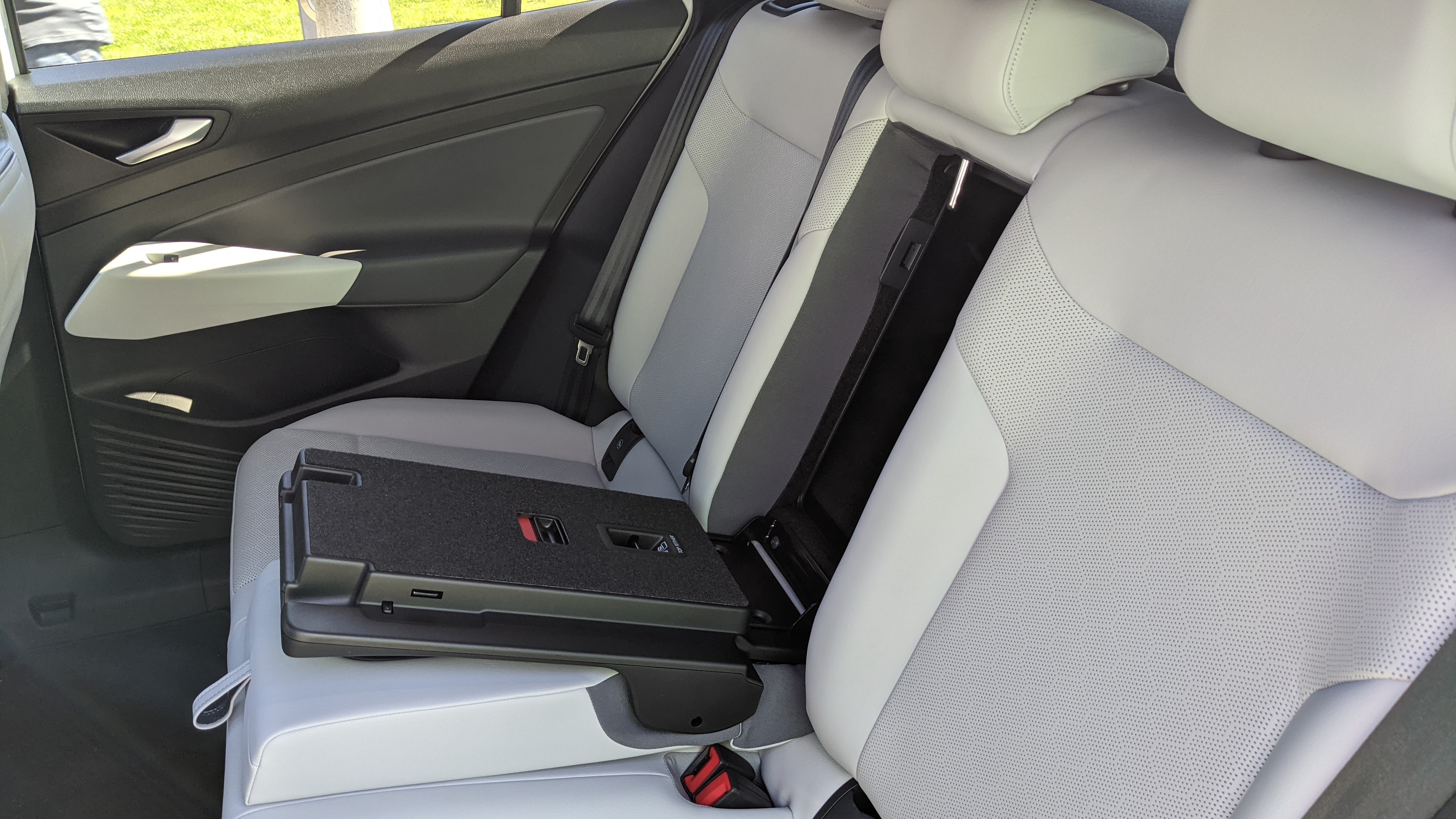
The back seats are firm and comfortable and unlike other EVs I have been in (except  the S) the ID 4 has the extended seat cushion to provide greater leg support. Super nice!  But also deserves a mention that the legroom of 78.7 inches (front and rear combined. If you don't know me I only look at this number since seats move! Makes no sense to look at anything else) is actually effectively more than other EVs because the longer "bench" means less legroom is needed in the back.  I had over 6" of clearance!


Access to the hatch; very convenient! 


Front seats. Again, long seat and this pix "highlights" the uhh arm rests! (you can see it in the extreme lower right hand corner of the pix) Did I mention the day was gorgeous and sunny? I mean like VERY bright sunny? 

The Toys


Ever notice how a lot of cars are designed for one? My Prius was this way. The SL version of the LEAF as well plus a bunch of others.  The driver gets everything, the passenger...not so much. 

Well, VW acknowledges that friends and spouses need benefits too.  Both front seats comes with power 12 way seats, two memory settings AND a vibrator! BOTH SIDES!!  Now, I didn't try the vibrator (kinda not sure I want to be more relaxed while driving??) but I do see it being a benefit to the more high strung, road rage, stuck in an one hour traffic jam, South Sound driver. 


Wireless charging pad. For some reason there was an i phone in my car. My guess is its used in case I steal the car or maybe get lost? They would use the phone to retrieve me or at least give me directions back to the mall.  I did try my phone and it connected just fine.   Funny thing; during the drive, I set my phone in the cup holder then started getting messages "Charging device" then "unable to charge device" then "charging device"  Apparently someone mentioned there is a charging pad on top as well. Nice. 


Inside hatch release. NICE and unlike the hands free auto release, this comes on every model. With a restaurant and grocery pickup being much more of thing because of COVID, this is a good thing! 


Because of COVID, social distancing and all that stuff, I had a 3 minute orientation on loading my route into the NAV and that was about it. I did the test drive alone and in hindsight, I should have pulled over somewhere and spent more time trying to figure out how stuff worked but one the strangest things I came across was the window controls.  

Notice only two buttons? Well, there are 4 windows. Apparently to control the rears you have to touch "rear" to switch modes. Cost cutting? Are buttons really that expensive? 


The center screen is 12" and bright, easy to see even in bright sunlight. Now the car I drove has a moon roof which was thankfully closed when I got there. As the driver, the moon roof provides zero benefit to me. I don't need encouragement to have my "head in the clouds" while driving and in Western WA, its nearly always clouds which sucks without the warm fuzzy feeling that comes with sunshine in the process of attaining skin cancer. So its anyone's guess as to how viewable this screen would be when the shade is open (yes, its just a shade, not a cover) 

4G is the standard powered by the "integrated" antenna and don't ask me what that entails but sounds like another cost cutting move by VW.  There are tactile buttons for the very basic climate controls but changing screens requires you to hit the blue  "X" on the left and either go back to the  prior screen  or select a new screen from the  options that are just below this pix. There are 4...not many.  

Now a lot of people love "auto" this and auto that so this is definitely aiming at mainstream but I am not one of them. I am constantly playing with my climate controls so physical buttons are highly desired for me.  But again, the very limited time I had with the car did not allow me to see if I could learn to live with this? 


The driver's display look decent here but its actually pretty small. Much smaller than I would have liked. Glancing at it thru the steering wheel was hardly impossible but felt more tedious than it should be.  It wasn't until I saw a blown up shot of the pix that I noticed things I didn't notice on the drive. That tells me this needs to be bigger. 


The Drive

Well, it was SHORT and didn't reveal a whole lot. Being unfamiliar with the car, I should have brought along a friend or two so I could observe the car while they drove.  COVID restrictions prevented the ambassador from accompanying me. It would have been nice to have him pointing out things I hadn't noticed. 


What's missing? In case you don't know; you can  click on the pix to get the full 4K version.  With the FOB in the center console (next to the i phone that was spying on me) I only needed to step on the brake pedal to start the car. Start up was silent so other than the screens lighting up, there was no indication  I noticed that told me the car was ready to drive.  

As you can see here, the driver's display is about a third the size of my LEAF. 

The shifter is mounted to the side of the driver's display and its the typical shift once rotating away from you to D, shift again to B. Rotate towards you once for R, twice for N.  As expected, you can shift on the move. I did not test to see if N could be quickly shifted by trying to shift to R but guessing it can. 

Another personal preference here. Maybe its my subconscious  pining for the old days of manual transmissions controlling my tendencies but when I drive, I am constantly shifting from D to B to E Pedal with an occasional N; only the Eco left on all the time.  During the drive, I found this shifting location to be very inconvenient.  If you are a set it and forget it driver, this will work for you. 

Yeah, the shifter location takes the fun out of driving. 


After start up, the natural thing was mode selection. Sport mode was the default although I suspect it will maintain whatever mode you select. Unlike many, I like the "EV" feeling. The regen, etc. So I selected Eco and during the drive, I switched around to see if Sport affected acceleration (it didn't but was supposed to stiffen suspension and that sort of thing. I didn't really have that kind of route so...?) 

Honorable Mention; The button at the left bottom the "P" menu is VERY cool. When you select it, it engages the camera based on the direction you are moving. Ever been in a tight parking space and not sure you can clear the car in front of you?  The overhead 4 camera view is nice but sometimes small, right?  Well, hit that button and the camera looking the direction you are traveling will take up the whole screen. This means being able to clear the car in front of you with inches to spare in confidence.  VERY VERY NICE! 


To start the drive, a pre selected route was programmed in and the NAV worked ok but a bit sluggishly.  While still in the parking lot of the mall, I purposely turned one block early and the NAV immediately told me to make a u turn. I had navigated back to the route before it was able to recalculate and direct me again. VERY slow. My phone takes about 2 seconds to do this.  

Now, driving by NAV shouldn't require looking at the screen at all and this one did a good job of that (if you didn't stray...) with good voice directions  although a bit earlier than I would have liked and even had dash lights that flashed green in the direction you are supposed to turn (red if you didn't...) 

The car drove with no discernible regen in Eco D which would be good for coasting but felt like it would be harder to control w/o braking. Eco B did work well with a much smoother transition from power to regen slowing the vehicle down to 2 mph. There was no one pedal driving mode that I could find.  Now the car has adaptive cruise control which could provide the one pedal driving in stop and go but the test drive simply didn't allow for testing that. 

The car did drive like a full size SUV but lacked body sway and roll. This could be partially due to the low speeds of the course but it had a very solid road feel and transmitted very little of the street imperfections to the cabin; a luxury type drive for sure. Acceleration was modest...very modest. TBH; I am a bit scared of my Plus's acceleration and although probably a bit slow for a lot of people, it has enough for me. If I had to compare, it would be close to the original 2011 and 2012 LEAFs. 

After barely a few miles, I was directed to make a u turn so not even a loop course. Quite disappointing really. With 200 miles of range, I should have taken it a few exits down I 5. With luck, I might have made it back to the event before the cops caught up to me...


The Score

I have to say, I didn't even scratch the surface of all the things the ID 4 has to offer. Dual zone climate controls, cross traffic alerts, lane guidance, adaptive cruise, etc but that is to be expected. It took a few days to get familiar when I took my Gen 2 LEAF home and that is after already being familiar with half the car! So there is no doubt I missed things that should be here so hoping you got enough here to decide if its worth a look to you. 

If you are into mid sized SUVs like maybe the Chevy Equinox, then this is worth a look for sure. If you are more into the personal transportation for yourself or your partner, this might be more car than you need. 

The base starts at $40,000 and not sure what the options will be. I am not a fan of RWD so that's a point off.  AWD will be about $3600 more I think and might be here by 2021. The date keeps getting pushed back so we shall see.  It also comes with THREE years of free access to Electrify America (what a shocker, right) which will help with those low efficiency numbers. 

As far as range, its 82 kwh or 20 kwh more than my LEAF but unlike my LEAF which easily exceeds the EPA rating, I am not as confident the ID 4's 250 miles will be as easy in as many different scenarios. In my very limited low speed test drive (not counting the 2 launches I did) it would appear I got 3.3 miles/kwh. If 77 kwh is available, that is only 254 miles so getting that on the freeway?  Either way, it should still be well over 200 miles which is really all we need between personal breaks anyway. With EA popping up like COVID cases, having one in a convenient place is becoming easier every day. 

The different tire sizes is a miss for me as I am a rotation fan.  On a per tire basis; 4 tires cost less than 2. VW, why??  The first thing I would do if I bought the car is match the tires as soon as they wear out.

Oh, the score? Cmon man!! Its an EV!  100% ALL THE WAY!... for someone 😉


Friday, March 5, 2021

February 2021 Drive Report; More 12 Volt Battery Info

Ok, another month in the bag and despite going to level 1 restrictions statewide, I am still driving much less than normal barely logging 800 miles in February so spent very little money charging. Since this wasn't an adjustment month and February being a short month means my typical 30 day electric bill hasn't dropped yet either so anyway that is the drive report for February so in other news...


Chevy Offering Free Bolt Upgrades

Well, obviously not something Chevy is advertising. Right now, their main push is the April software update that makes their car "completely" safe and returns them to 100% range (or whatever they had)

BUT...

Today, a Seattleite turned in her 2017 Bolt LT with 20,000 miles on it and got a check under the buyback program that covered her entire purchase price minus a $5000 usage charge.  The check included taxes, yada yada. But this allowed her to immediately buy a fully loaded 2020 Premier for the EXACT SAME PRICE 

She had filed and received the full $7500 tax credit so she basically received a buyback check for more than she had paid for the car. 

In short; she arrives at dealership in an old beat up car, receive check, sign the back of the check, hand to dealer, drive home in brand new Bolt with all the bells and whistles she had always wanted but did not have. (Ok, so her car was probably in pretty good shape with many years of driving usage still left in her but you get picture. "very good shape" ALWAYS comes in 2nd to "New car smell") 


Electrify America Backtracking? 

Recently someone posted a link to an  EA station in New York boasting TWO combo CCS/Chademo stations. This was BIG news... for a day.  Although listed in the EA app, its a co sponsored site with EVolve NY.  So, looking like this is a special config site and not a new direction for Electrify America. Oh well... 

Speaking of EA, they teased us with a Port Angeles site covering half of the Scenic Olympic Peninsula Drive then announced Aberdeen! The first DC charger (non Tesla) in Grays Harbor County! THIS...IS...BIG!

So, yeah I will still glare at them for how they slighted us Chademoians but probably thru sunglasses. The Bastards! 


Blink On The Move? 

A few weeks ago, I received 3 separate notices from Plugshare that Blink had activated new charging stations; something I hadn't seen in SEVERAL years. Then they announced Brendan Jones was the new COO. For those unfamiliar with his name, he was one of the major players in launching the LEAF in North America as an employee of Nissan. He then spent time running EVgo and more recently Electrify America.  Blink remains one of the two Chademo only DC station (with level 2 AC's of course) operators in the region and like Webasto, has had very little movement on the expansion front.  

Also like Webasto, they also improved dramatically on the maintenance side (which for Blink meant doing "anything" as they did absolutely nothing for years) fixing stations that had been broken for YEARS and reducing the repair time when stations break. 

Hoping Jones can bring some new life into the company including a more flexible billing plan and more stations. 

12 Volt Battery Saga; Part....??

As you know, I have had some concerns with my 12 volt battery reaching new lows not seen in a decade of LEAFing to where I finally decided it was time to start boosting the battery. Now, I had always threatened to do this but as long as my low water mark was 12.15 volts, I held off.  But readings below 12 volts was simply too close to walking for my comfort. 

But boosting a complete charge cycle didn't help. Within 2 or 3 days, I was back under 12 volts so

Disconnecting Wi Fi

I decided to start removing things I never had including Wi Fi. So I turned it off, and off...and off.  For whatever reason, the Wi Fi would not stay off more than a few days.  At first I thought it wasn't saved but there is no way to save or submit changes.  Then I thought it came back on every time it was power cycled but that wasn't it either. It just randomly turns back on. So now I regularly turn the center screen on (don't have NAV so why have it on?) check my connections, disable Wi Fi if need be. every 2-3 trips or so. I have it down to where it only takes a few seconds. I guess practice makes perfect and I have had a LOT of practice lately!

Charging Every Day

Now, I have always recommended charging daily to cover the day's needs over charging to 100%  a few times a week like many seem to think is so much easier.  I recently had a discussion with another Facebooker about charging and he claimed using a timer to charge to a target SOC was too hard and complicated. He claims the new packs were not vulnerable to time at high SOC and it was simpler to charge 2 or 3 times a week instead. I tried once to elaborate and that didn't work so off we went on our way.  But this is just another (or many) reasons to charge every day. 

So how is this related to my 12 volt battery health?  LEAF Spy displays the voltage and current going thru the 12 volt and when I charge the traction pack every day, on start up every morning, it would nearly always show the voltage at 13.04 volts more or less with current being very small generally under ¼ an amp.  Now, as we know, the Gen 2 LEAFs boosts the 12 volt every day under normal circumstances. I could also check the charge level of the 12 volt by turning on the windshield wipers. The voltage would jump to "charge range" or about 14.4 volts or so but when charging every day, the current would mostly (19 of 21 days) be low under .1 amp.  IOW; Nissan  had determined the 12 volt was charged enough. 

BUT on days when I did not charge, I was seeing the higher charge voltage and up to 3 amps of current.  This morning I started the car and saw this; 


On the screenshot in the lower left corner you see the 12 volt status; 14.48 volts @ 2.98 amps which means its nearly a full blown boost. I checked several logs and the highest I saw was just over 4 amps so this is just about as good as it gets.  

So, I let LEAF Spy run until the 12 volt dropped to 13.04 volts which is essentially the LEAF DC system running.  This signified the end of the boost.  So I turned on the windshield wipers and the current went up when it hit charge voltage and gave me another 7 minutes of boost. This means the LEAF is simply boosting the 12 volt on a schedule and not due to the actual SOC of the 12 volt battery. 

Hx

Although I am mentioning Hx, I still don't specifically know what it is. If you recall, I went thru Q4 2020 running my SOC mostly between 20 and 45% and that was causing my Hx to creep downwards. Now don't know if that is a good thing or bad thing although I will say I noticed a lot of 40 kwh'ers with low Hx under 105% who were beating the clock on degradation so got it in my mind that a low Hx might be a good thing to aspire to.  

Well, I knew DC charging caused Hx to rise usually so I cut that out. 

So we move to Q1 2021 and I moved my SOC range up to between 35 and 70%.  I did do 2 full charges during the quarter but other than that, I never went over 70% (which was one of the full charges) with  2nd highest being 64% and at first, the Hx was continuing its decline although I will say it slowed a bit including a stretch of 5 days  when it didn't change at all which is unusual as it normally changes every day with only an occasional pause lasting no more than 2 days.

But now, its going up and has risen steadily for the past 3 weeks. It has been warmer for the last 9 days but wasn't the during the earlier part of the rise so I guess we shall see what transpires. 


Friday, February 12, 2021

12 volt battery

 Thurs  2/11

Checked voltage;  11.98 volts, garage temp  53.8º


0816; Started 12 volt charge in car; 


0850; 75%,  14.26 volts at battery

1010; 75%  14.49 volts  

1050; 75% Removed charger, batt voltage 12.75

1125; 12.55 volts

1248; 12.48 volts

Played in snow (went grocery shopping) 


Friday; 2/12

0645; OAT range last 12 hours; 29-27ºF, Garage; 50.7ºF.  12.00 volts.  Did manual update search, disabled wi fi. 

Saturday, January 30, 2021

LEAF 12 Volt Battery Health

 Its that time of year when we are monitoring the weather report to see if road conditions warrant leaving for work 15 minutes earlier to make it on time. Its all about managing snow, sleet, ice and...your 12 volt battery. If you are a member of several LEAF groups like me, it will likely take you  less than 5 minutes to find one "car won't start" post and the culprit 95% of the time?  You guessed it.  So some ideas of keeping that battery reliable thru the Winter is something I think we all need to investigate.

Lead Acid Batteries 

12 volt battery issues during Winter didn't start with the Nissan LEAF.  I can't tell you how many times I cussed and bitched every time I couldn't get my $115 (yeah that is what I paid for it) Chevelle to start on a frigid January morning when living in Michigan. Being less than 5 miles from Lake Huron meant it wasn't a "dry" cold, it was a "feel every single degree of icy chill" cold along with that "nice" breeze. As a teen, I was lucky to have a car (although where we lived, you really didn't have much of a choice. Our town had no bus service that left town and we didn't live anywhere near town) but nowhere near the status of being able to park in the garage so it was all about my car not freezing over night while parked under the Elm tree in our yard. 

This meant at least half a dozen times a winter getting Mom's keys so I could jump my car with hers while hoping my fingers weren't permanently frostbitten during the process.  The reality is cold cars don't want to start first thing in the morning.  Now this was a 12 volt battery that was immediately topped off to a full charge right after starting. Right where lead acid wants to be; fully charged.  But if driving an EV (No, the LEAF is not the only EV with this issue) you are not afforded all the advantages you could have in the frigid fight of the Fahrenheit!


Nissan 12 Volt Management

Nissan's BMS charges the 12 volt battery on a regular basis triggered by several different events.  Starting the car is one, having the car sit for an extended period of time is another.  In none of these cases is the 12  volt battery fully charged. When 24 kwh packs were the norm, I could understand Nissan not wanting to spend a lot of electrons on topping off the 12 volt battery. So it was really all about creating an algorithm  that would boost the charge enough to keep it in the safe zone and for many of us, it works.  But the number of people who do have problems along with much larger packs suggests Nissan could be doing a better job. 

To be fair, they do warn you when the 12 volt battery is low (now why that warning doesn't trigger additional charging sessions is anyone's guess)  but like all "idiot" lights, by the time you see it, damage has already been done. According to Battery U, time under 50% SOC on a lead acid battery PERMANENTLY devalues the capacity. 

Symbol appears in upper left corner of the screen in red
 

The Test Part One

I park in a garage which means my 12 volt issues will be greatly mitigated simply because the battery won't get nearly as cold as one sitting outside. I also live in the Pacific Northwest 3 miles from the southern apex of Puget Sound which means pretty mild winters for the most part. 

Now because I have a Plus and a 28 mile roundtrip 4 day commute, I could easily gain enough range the night before my workweek began to cover me for the  week without any additional charging.  I did this for 4 weeks checking the battery voltage in the morning before taking off for the day.  The results were not encouraging. 

Day 1 range; 12.28 to 12.55 volts

Day 2 ranged from 12.15 to 12.41 volts

Day 3 ranged from 11.91 to 12.31 volts. 

Day 4 ranged from 11.99 to 12.21 volts

Now its obvious that the car is getting a boost from the battery during the night at least occasionally. This explains the high end voltage readings. Most of the readings were nearer to the low end of the range. Now I think with the newer LEAFs, the  12 volt gets boosted daily but was unable to capture it charging. Leaving LEAF Spy running all night is an option because it will only stay connected if the car is on which would have changed the algorithm  that controlled the 12 volt charging mechanism so I set up my Go Pro on the slowest frame rate to run all night to try to to catch charging sessions and it failed to capture anything in 4 days. When the 12 volt battery is being actively boosted and the car is not charging, the right charging light (facing the car) on the dash blinks. I will probably revisit this. 

NOTE; For anyone wondering how much power the car uses in the "on and parked" state. I split duty with my dryer plug to charge the car so am only running at 5.88 KW (240 volts, 24 amps)  LEAF Spy shows power in and out of the battery and here you see a .5 amp difference between car on, car off. Using the "PIE" formula (volts * current = power) You can see 5.22 KW of the 5.88 KW feed making it to the battery with car off.  With car on, its 5.04 KW. 


During this time, garage temps ranged from 48 to 58º and a few times, I was wondering if I should grab my boost box. 

Garage temp 51.9º 6:55 AM, car last driven 6:22 PM previous day

Luckily the car still started. I couldn't help but wonder if it would have started if parked outside when the previous overnight low was 39º?  After the car started, I decided to charge to see how long the 12 volt battery would boost.  

Lead acid needs over 14 volts to charge and LEAF Spy logs verified the 12 volt charging at 14.48 volts, just starting just 3 amps. (FYI; LEAF Spy not running the entire time so normally we would see a lot more entries in the drop to under 2 amps with each entry ~ 6 second intervals) 


But the battery only charged for 6 minutes.  FYI; I have a 12 volt battery charger that recommends 4 amp charging medium duty (cars) so 6 minutes? Yeah, barely qualifies as life support. 

Now this may come as a shock to some but there are misconceptions going around on social media including the fact that the normal voltage the LEAF 12 volt DC system runs on 13.04 volts; is enough to charge the battery. This is NOT true, not even a little tiny bit.  The battery is essentially electrically disconnected from the system. 

I then scoured my LEAF Spy logs and found the average to be around 4-5 minutes for a boost with some being as short as 2 minutes. I did see one event that went 7 minutes until LEAF Spy was shut down. Had I only known...

Test Part Two

This part of the test, I measured the voltage every morning when I got up like part one but this time, I plugged the car in immediately afterwards. I would only be charging for ~ 75 minutes so SOC was still quite low (under 50% most of the time)  Since I was charging every day, there was no sense in breaking out day one, day two, etc. so I took 8 measurements (2 weeks worth)

Range; 12.18-12.71 volts. (ok, the 12.71 volts probably should have been tossed out as 2nd highest was only 12.48 volts) 

Wow! so charging every day definitely helps but not nearly as much as I had hoped. I will say that the garage was colder as low as 46.8º and the highest during this time was only 53º. Unlikely significant...

NOTE: Although my car enjoys the pampered life at home, she is just another car at work braving the elements in an uncovered lot for 10½ hours a day.

Living On The Edge

All this made me wonder "Just how close am I to the flame?"  So I went out, checked the battery and it was its customary range at 12.12 volts with the garage at 57.4º. I disconnected the battery entirely from the car and it read 12.30 volts.  I knew that my trip computer would be reset when I disconnected the battery so I turned on the car just long enough to get my LEAF Spy readings for the day before doing all this.  But a .2 volt drop from the system was an interesting data point. 

NOTE; I don't have telematics (Nissan Connect, CARWINGS or whatever its called nowadays) but I do have Wi Fi. Its my guess that Wi Fi is not active when the car is off so shouldn't make a difference. 

So I hooked up the charger. Voltage went to 14.40 volts so a bit lower than the LEAF system. And...


Well, not looking super good (to say the least) 

It did move to 50% in less than 3 minutes. Another 13 minutes to 75%. The time to 100% will be of less value because when the charger senses the voltage starting to rise, it will cut back the current and I have no real way of knowing how much. Either way, I am charging 50-100% faster than the LEAF would be so its pretty obvious that most of the boosts are coming nowhere near bringing the battery as high as 50% charged. Now for Lithium, that would be awesome but Lead Acid? 50% ensures an early death. 

I let the charger run for 40 minutes disconnecting when the charge voltage hit 14.52 volts which was near when the current would likely start to drop. After reconnecting the battery, I waited 5 minutes and checked it. 12.33 volts.  Don't know how much good it did but I sure feel a lot better about it. 

FYI; Temps expected to be below freezing tonight 😉

EDIT

Naturally a few days after I publish this, Elon responded. He is usually pretty good about that ;) 


Saturday, January 9, 2021

December 2020 Drive Report; Hope For The New Year!

2021 promises a reset of the challenges faced in 2020 but the progress is slow. WA is still locked down for all social activities so its take out only, no sporting events, concerts, movies or much of anything else.  Although retail locations are restricted to 25% capacity, other than small (easy to track) shops in the malls, there is very little policing going on.  Each store does have people out front going thru the motions but I have only encountered one line at Costco (didn't go in) but other places like Safeway was packed and pretty sure they were well over the 25% limit but so far, no infections


As you can see; as of Wednesday the 7th (when I took the test) I am free to roam...with a mask of course. Since the test, I have only had close interaction with my Son who sees no one other than immediate family as he is still doing CFH (classes from home)  and a few different people I picked up food from and yes, I and they were wearing masks.  

As far as when I will be able to take more advantage of my range, that remains to be seen. Restrictions were supposed to be "adjusted" on the 4th but were extended to the 11th and then an announcement by the governor is breaking up the state into regions where different levels of restrictions will apply. Due to paywall issues, I have no other information than that but its my hope by this time next week, I will be able to do something besides shuttling a few miles for food and groceries. 

I will be getting the vaccine when its available and due to age and occupation, I will likely be in the first 3rd or so in WA? But still looks to be not before early to mid Spring, so that is a long way off not to mention the 30 day 2 shot process and the several days of immunity building before I am "relatively" safe. 

The Numbers

December as expected saw me under 4 miles/kwh barely. I am actually surprised I came as close as I did due to my higher average speed on my commuting but guessing climate control experimentation played a small part but ended the month going 810.2 miles @ 3.96 miles/kwh costing $19.86 or 2.45 cents/mile. That is a slight drop from last month despite higher utility rates which I calculated at 12.21 cents/kwh. Due to the rate change in the middle of the month, a straightforward calculation would have been tedious so I split the taxes, etc. 50/50 although my tier one/ tier two usage was 600/450. All my EV charging was tier two.
For the year; entire fuel cost was $194 and change which included $42.10 in public charging fees, most of which happened when I was homeless. At 13,985 miles that works out to 1.39 cents per mile. I can live with that. Unfortunately the loss of NCTC likely means an estimated 240% increase in cost.

Degradation Predictions

"Probably" should have waited another 2 weeks for my adjustment but as you can see (the black arrows) in the chart, the last one was hardly a thing and I am expecting more of the same. What the chart portrays is projected ahr/SOH @ 100,000 miles using current degradation trends from day one. Although I have date lines, this data points are logged every 1000 miles.
Now if we were to use only the trends of the recent past; .03% SOH the last 1k miles or .04% the previous 1K miles, I would hit 6 figures around 90% SOH. Unrealistic? Well, there are already 4 LEAFers over 100,000 miles and two of them are still over 90% SOH so yeah, its possible. Obviously they have a much lower level of time based degradation.


Here is the latest entry @ 16,003 miles and I guess we can say things are looking up 

By Date

By miles

Notes; There are now 4 LEAFers (40 and 62 kwh) over 100,000 miles with no capacity bar loss including at least one still over 90% SOH.  Granted their timed based degradation will be less than mine, but so far things are looking good.  We are still searching for the first lost capacity bar. If you know of one, grab some pix and comment below! 

Climate Controls

Recently I discovered my Plus has gained a lot more climate control options.  Not sure my 40 kwh could do some of the stuff but I know my older LEAFs couldn't. 

As we know, heat is the big range killer so using it sparingly is the easiest way to boost range on those longer drives. Here in the Pacific Northwest, the challenge is even greater due to the high humidity that comes hand in hand with lots of rain. So anyway, I am buzzing over to grab dinner and have defrost on and as usual, I am toggling the heat button on and off based on how much comfort I need and got stuck behind a smelly at the light. I immediately closed the vent but since it was pouring rain, I knew fogging would quickly become an issue so I left the A/C on. 

The light turned green, I proceeded to my destination and sat in the car waiting for my food to arrive. (carside delivery) The food came out after a 3 minute wait and off I went and that is when I realized the vent was still closed and until hot food was introduced,  the windshield stayed clear!  This was a shock!

So I decided that I would investigate further so the next day. I drove around this time with LEAF Spy running and results were pretty cool 


The phone covers it but I drove around all 
day w/o heat. The day was mild so not an
issue! 

Here there is no power draw but I did see power occasionally, so had to access LEAF Spy logs and saw power ranging from 200 to 350 watts briefly but mostly zeros.  On the chart below, the number you see is the power used in 50 watt increments. So 1 = 50 watts, 2 = 100 watts, etc.  Each reading happens roughly every 6 seconds


Now the weather was a lot drier than it was the previous night so unable to know how bad fogging would be but there would definitely some fogging normally as only the driest, sunniest days are fog free when the vents are closed. I did have light rain in the morning but it was mostly dry with sunbreaks in the afternoon. 

Now there are caveats to this method. Although the A/C is not "technically" cooling the air, removing moisture will lower the temp of the air somewhat. I much prefer the closed vent option especially around town and found that blowing cold air on my feet was easier to tolerate than the face or windshield. It did irk me a bit as the front left vent on the dash leaks but I simply pointed it to the driver's window and that fixed it. 

On milder days in the 50's, it was easy to never turn on the heat. I did toggle heat on/off on a roughly 30/70% cycle in colder weather in the 40's down to the upper 30's when the heat was on most of the time. I will be playing with much more but so far, very impressive results. 

Electrify America

I can't even tell you how much it irritates me that my most hated public charging option is becoming so useful! As mentioned, the Olympic Peninsula Scenic Highway is a major challenge even for long range (200 mile plus) EVs due to no DC charging! Tesla has it covered but that is all.  Well, things have changed as EA has sited and will soon break ground on key locations in Aberdeen, (first convenient CCS/Chademo plug in Grays Harbor county!) Port Angeles, and Poulsbo, WA.  This makes the longest distance between DC chargers at no more than 164 miles which literally takes all the challenge away for me.  Even 40 kwh LEAFers can make it with a few short pit stops at one of free level 2's along the route and there is a LOT of places worthy of a visit!  


All will be located at Walmart.  To be fair, I should mention that Leavenworth, WA (our Bavarian mountainous, Christmasy town) another popular destination will also have an EA location but that area has several DC stations already but as we all know; on busy holidays, there is never enough plugs so the more the merrier!  

We also have a state sponsored public charging rollout(most notably Highway 12 over White Pass) that EA is partially involved in (not sure how much the state has involved in these new EA locations) which means more stations coming.  I have requests for Forks and Shelton which will be very helpful as well. 

But the convenience is "nearly" overridden by the crazy per kwh rates EA started last year. I suggest we all send our thoughts to EA about this. We live in one of the hottest EV adoption areas and we are paying THE highest rates for a charge. Something is not right here!  


Friday, December 4, 2020

November 2020 Drive Report; Winterizing Your Drive

For the month, I only went 738.0 miles averaging 4.05 miles/kwh. With a charging efficiency averaging 88%, that means  207.1 kwh put in.  FYI; DC efficiency is much higher averaging 96-97%. The lower mileage is representative of increased COVID restrictions. The theaters are closed, dine in isn't an option so... life is kinda boring. I admit the movie thing isn't a great hurdle. I have surround sound and 75" so if I slide my chair a bit closer, it really isn't all that bad I guess. First World problems are Hell... A friend doing WFH is getting into meal delivery services and I thought about it as its definitely a healthier option than what I am doing and right now there are some great prices making the difference in cost not so much. But that would be more time at home and not sure I want to do that. I do cook regularly but my skills are limited. I should really invest in a cookbook and get a hobby! 

The Worm Has Turned!

My last blog was my one year review with part two mostly examining LEAF Spy data on battery degradation. There I predicted my next adjustment due in Jan will either be positive or zero.  I also track my stats every 1,000 miles and probably will create another parallel chart for every month but I set a new record for degradation (the good kind of record!) At 15,000 miles (more or less) my degradation was .05% loss from 14,000 miles covering October 22 to November 28.  This nearly cuts my previous record of .09% in half.  I also set another record of sorts when my stats didn't change for 21 days. Previous high was 10 days. 

Now, the reduced driving, 100% L2 charging and the colder weather is also likely playing a part. How big is anyone's guess but realize my 2018 went into super slow degradation mode in July so not putting a lot into the "cold battery hibernation" theory that many people seem to like. 

On the 2018, I got it mid Feb so still "winterish" but much closer to the start of warmer weather but nearly the same thing happened on its one year anniversary where I had no changes for 16 days running from 2/13/19 to 3/1/19.  This happened on the change from 93.00% to 92.99% SOH.  The Plus record happened on the change from 93.13% to 93.12%.  Based on this info, I have determined the Plus is .13% better than the standard!!

(I hope we ALL realize I was kidding on that last part...) 

Charging Issues

Ever get the red flashing error on your EVSE? Usually comes with a dash emoticon? You may have or have not noticed it but its likely everyone has seen it a few times. The error condition corrects itself most of the time so not always noticeable.  I used to see it maybe a few times a month. I unplug 100% of the time when the charge is active since I never charge to full (or anywhere near it lately)  So what I have been experimenting with is squeezing the trigger on the EVSE first, waiting until the pump stops (like one second) running then unplugging. So far, so good. I didn't really track how often I got the faults but in my estimation, I have probably exceeded the time I would have seen at least 2 by now. 

Topping Up

The weather is either cooler or getting downright cold. Your LEAF, just like any other car will see diminished range because of the cold weather. Cold air is denser meaning if nothing else changed,your miles/kwh performance drops with the temperature because of the additional molecules. Not a whole lot you can do about that but there are a few things you can do in advance to minimize those inconvenient moments cars tend to throw at us at us when the weather turns. 

Top off your windshield wiper fluid.  Its the easiest thing on the  list and one of the most vital especially if you usually see snow. Snow on the roads quickly becomes slush mixed with oil and other gasser junk. Wipers alone have no chance against this toxic mix. Being caught short on windshield wiper fluid is not only inconvenient ($15 at 7-Eleven verses $5 at Walmart) but its dangerous. 

Related to the fluid is the wipers themselves. I will admit that I only change the short blade every other year but change the long one "around" November.  Because of the size of the blade, curve of the windshield or whatever,  not all replacement blades work with the LEAF. Costco was infamous for stocking ones that were garbage. Now this is a bit more work but one thing I found that worked very well is replacing just the blade itself. I get mine at the local Honda dealer. Under $10 and it would be classified "very easy" on the DIY scale I think.

Driver: Honda 76622-STK-A02 

Passenger: Honda 76632-STK-A02

Rear: Honda 76622-T7A-003 

Tire Pressures need to be checked. Do it first thing in the morning before any driving if parked outside. Remember tire pressures should be checked during the coldest part of the day. Tires will lose about one PSI for every 10ºF drop in the temperatures.  Another reason to check before any driving is tires heat up unevenly so checking them after driving means your front tires will read a bit higher than the backs since the fronts do most of the work. 

Check your 12 volt battery. Like any car, your LEAF will not start without a 12 volt battery in "reasonable" shape. Yep, that is all we need, one that is barely alive but even that is not always possible with Nissan's 12 volt battery algorithm.  I am happy to report that initial analysis indicates the algorithm has improved on my 2019 Plus.  But improved does not mean "fixed" 

Lead acid for longest life wants to be at or near a full charge. This means nearly 13 volts (why is it called a 12 volt battery then?) Now the LEAF puts a load on that 12 volt battery 24/7. That is how it remembers your radio stations, etc.  That load is pretty low most of the time dropping the voltage a tenth or so. 

Things that can increase the load;

Charging or being plugged in and not charging (charging complete or on a timer)

Telematics like Nissan Connect. 

Walking near your car with fob in your pocket. 

Auto headlight settings or anything else that stays on after you shut the car off. 

So right now I am in the process of trying to figure out if the 12 volt algorithm responds to outside influences. To do that, I have to have a general idea of when the car actually charges the battery when its sitting.  To say tracking this process is frustrating is an understatement.  First thing I tried was Go Pro on the slowest frame rate. Two nights, zero results. Will go deeper into this soon. 

But I am waking up to a battery that is anywhere from 12.65 (GREAT!) to 12.15 (ooooohhh...) volts.  Now, I park in a garage where the temps run in the low to upper 50's.  We had a burst of cold weather that lasted 3 days and the garage temps held up well so my issues aren't critical but if you are parking outside, you WILL have battery issues. 

Now, last year my car was new so I had little worries about the cold. My previous place, the garage was 5-10º colder due to a lot more shade (which I MUCH rather wish I still had!) but in previous years, once a month or so, I would boost the 12 volt. So if you have a charger, this might not be a bad idea. Don't be one of the 2-4 Facebookians I see posting dead 12 volt battery stories, daily. 

Finding Your Comfort Level

We all have comfort levels that vary a ton so saying what works for anyone else but me is really quite crazy but everyone does it anyway, so this is my disclaimer; 

I live in a relatively mild climate which means I have challenges...different ones. Because of that, some of what I suggest will sound crazy to people who live in more severe weather. 

Here we have rain...LOTS of it. This year, it hasn't happened like it normally does. Forecasters predicted colder wetter weather but we have been a LOT drier than normal. I don't remember the last time there was little or no rain predicted for the South Sound Region for the first 5 days of December. 

But one thing I have been experimenting with is running defrost with less heat. My Plus has separate heat and A/C buttons.  During defrost, A/C power is pretty low, generally 200 watts or less.  Heat is another story. On startup, it will get up to 3500 watts and slowly work its way down. But its bottom is generally 300-750 watts. (I have seen it at 150 but rarely and no more than a few minutes at a time) So being able to run (and see) with the heat off is a benefit.  I have just started doing this over the  past week and the rain issues have been mild so will report back in much more detail when I see how well it works on the milder, wetter days when fogging is a huge issue. 

Another thing I got was heated socks! Uses rechargeable Lithium and first trip out was favorable. Will have more on that later as well.  Just a few quick comments on the socks.  They are very comfortable so even as just socks, they are great.  I picked them up on Amazon for $25. They have 3 heat settings and only warm up the toes and ball of your foot. 

I got them yesterday so took off on a drive waiting till dark. It didn't get as cold as I had hoped as I was only using steering wheel heat and seat heaters using defrost as needed (light need) but I was very comfortable at 42º.  It was my goal to wait until my feet got cold before turning them on as I won't be wearing them on a regular basis. They will go in my "emergency" kit which also contains handwarmers, gloves, knit caps, tire socks, etc.) so its important to not test to see if they will keep my feet warm but to see if they can warm up cold feet. 

But I got to my turnaround spot and my feet were just starting to feel the cold so not cold yet. I will say even on the highest setting, the warmth was not overwhelming. Still much better than nothing and just the sock itself is much warmer than would I would be normally be wearing. So... stay tuned!